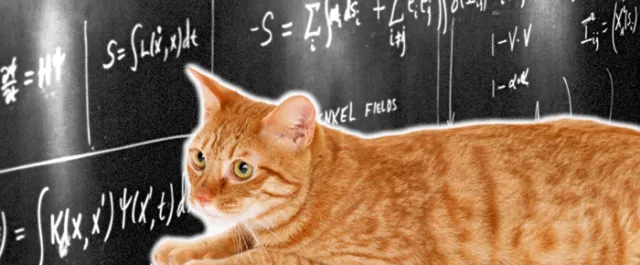
In a famous article written in 1960, The Unreasonable Effectiveness of Mathematics in the Natural Sciences, the physicist Eugene Wigner (see sidebar) examines the relationship between mathematics and physics and raises two questions:
• How can the same mathematical concept arise in situations that seemingly have nothing to do with one another, yet describe each of them equally precisely?
• Is the unsettling effectiveness of mathematics in the natural sciences, particularly physics, evidence of a one-to-one correspondence between theories and what they describe?
Take the simple formula c / d = π, which relates a circle's circumference c to its diameter d. Remarkably, the same number π also appears in the sum of the reciprocals of the squares of all odd numbers: The way mathematics enters physical theories can inspire the same sense of wonder: a single mathematical concept may prove extremely useful in widely disparate physical theories. This is all the more surprising when we consider theories in which mathematics is not merely a tool but plays a foundational role, tending to confirm the view generally attributed to Galileo that the laws of nature are written in the language of mathematics. This is true of the three great theories of modern physics: the theory of gravitation, quantum mechanics and quantum electrodynamics. Let us take a closer look at this "unreasonable effectiveness" of mathematics in action.