
Claire Voisin, an expert in Hodge theory
=================================================
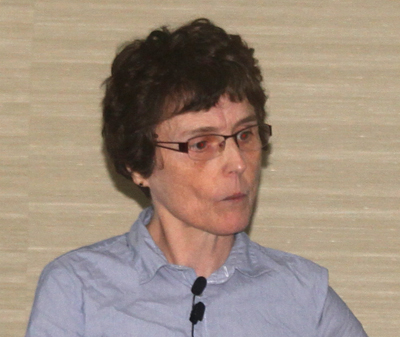
Each year, the L’Oréal-UNESCO For Women in Science Award honors five outstanding women scientists, one from each of the world's five regions. For its twenty-first edition, the award was opened to mathematics and computer science. Two mathematicians received the award: Ingrid Daubechies (for North America; see below) and Claire Voisin (for Europe). The laureates' names were announced on February 11, the International Day of Women and Girls in Science.
Awarded the CNRS Gold Medal in 2016 and the first woman mathematician to join the Collège de France as holder of the Chair in Algebraic Geometry, Claire Voisin has received countless accolades.
Her latest award shows just how exceptional her international standing is. The French mathematician, who began her career at the CNRS in 1986, soon developed a passion for Hodge theory (a tool for studying the topology of complex algebraic varieties). In 2002, she constructed potential counterexamples to the Hodge conjecture, one of the seven Millennium Prize Problems.
Her other achievements include a proof of Green's conjecture in particular cases (on the extension of certain curves), research on mirror symmetry and work on the Kodaira embedding theorem, which she proved cannot be generalized to every dimension. By forging links between algebraic geometry, topology and complex analysis, Claire Voisin's pioneering discoveries have helped resolve many fundamental questions.
Jean-François Le Gall, at the interface between PDEs and probability
====================================================================
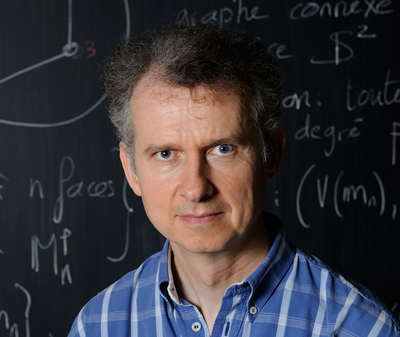
The Wolf Prize, awarded annually since 1978 to eminent researchers in scientific or artistic fields, went this year to mathematician Jean-François Le Gall (Paris-Sud University) for his "profound and elegant" research on stochastic processes. He shares the distinction with American mathematician Gregory Francis Lawler of the University of Chicago. Le Gall's research lies within modern probability theory. His work on Brownian motion led him to discover some surprising properties of points visited several times during Brownian motion. In random processes describing the evolution of particle populations subject both to random reproduction and to Brownian motion through space, he established links between this probabilistic study and the theory of partial differential equations (PDEs). Today, however, he is particularly interested in large random graphs drawn in the plane.
Ingrid Daubechies, a wavelet specialist
=================================================
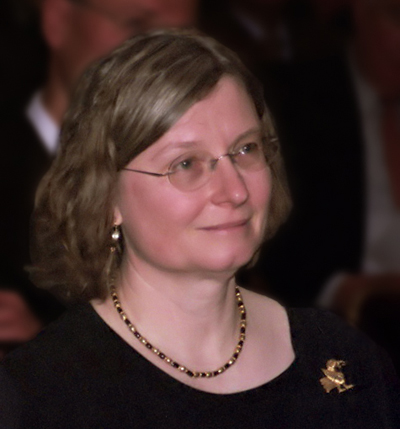
Ingrid Daubechies, a Belgian-born American physicist and mathematician with a distinguished career—she was the first woman to be appointed professor of mathematics at Princeton University, New Jersey, and the first woman president of the International Mathematical Union—shares the L’Oréal-UNESCO award with Claire Voisin (see above). She is honored for developing cutting-edge computational approaches that shed new light on our understanding of nanoscale systems. After completing her thesis in theoretical physics in 1980, Daubechies soon began working to improve Fourier analysis. Having contributed at several stages to the development of wavelet theory, she constructed compactly supported orthonormal bases in 1989. Known as Daubechies wavelets, they led to the development of an efficient image-compression technique and ultimately to the JPEG 2000 standard.