




Fascinants carrés magiques
This issue is not fully translated into English yet; only translated content is shown.
Read the French versionAll folders in this issue

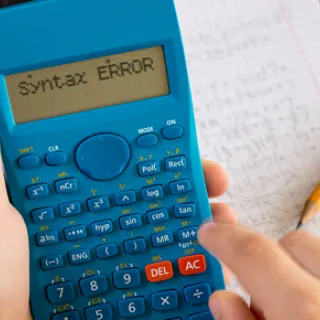
Errors and Approximations
Even in mathematics, kingdom of rigor, one cannot escape the necessity of making approximations or roundings, of bounding deviations or potential errors. The handling of floating-point numbers, which bridges the world of ideas and that of technology, is a fine example. The goal of exactitude pushes one to quantify the uncertainty imposed by technical or material constraints. Inseparable from scientific computing, including with computer tools, approximation can have far-reaching consequences. Yet some errors are famous for having, inadvertently, allowed a door to be opened toward a new universe.
Magic squares
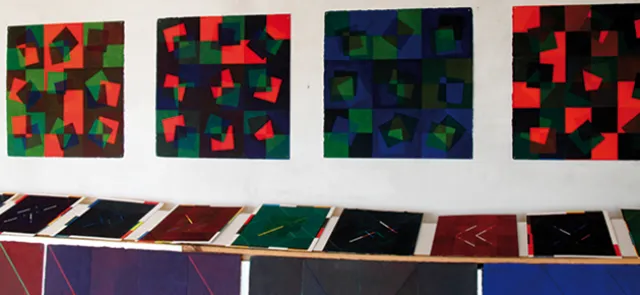
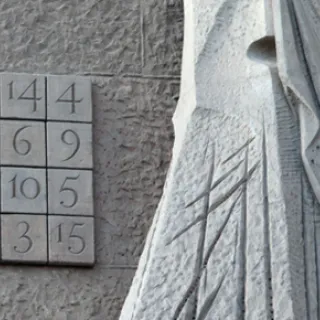
For centuries, enthusiasts of elegant arithmetic have vied with each other in ingenuity to propose ever more astonishing magic squares, with increasingly numerous properties. One of the experts in the field, René Descombes, shares some of his construction methods. While computer tools allow enthusiasts to expand their collection of achievements, variants continue to increase. Let us rediscover multiplicative magic squares, pandigital magic squares and other "magic" constructions. The arithmetic treasures they contain seem limitless and are even found in figurative art.
All articles in this issue

Morley's "miracle"
A symmetry appearing out of nowhere, an equilateral triangle emerging amid the trisectors of a completely arbitrary triangle: that is the whole "miracle" of Morley and his theorem. The many proofs of this beautiful property are marvels of geometry and trigonometry.

196: a very curious number!
A palindrome, or palindromic number, reads the same from right to left as from left to right, like 514,415. Here is a simple recipe for finding one.

Would you like a slice of a sphere?
John Conway passed away this year, but the profound questions he raised across many fields remain as relevant as ever (see Tangente 194).

Frances Allen (1932–2020), computing pioneer
Frances Allen was the first woman to receive the Turing Award. She died last August, on her 88th birthday.

Marvelous logarithms
Logarithms emerged at the very beginning of the 17th century, thanks to the eccentric Scottish mathematician and theologian John Napier. By dramatically speeding up calculations, they paved the way for extraordinary scientific advances, particularly in astronomy.

The unreasonable effectiveness of mathematics
In the latest physical theories, mathematical models have achieved such descriptive and predictive power that the question inevitably arises: is this mysterious fit a miracle, or does it have a deeper meaning?