This is true in knot theory. In topology, a knot is much what one might intuitively imagine, except that mathematicians join the two ends of the string together. Three-dimensional space allows the string to be knotted in such a way that it cannot be untied.
We can also play in four-dimensional space; the extra dimension then allows spheres, rather than just strings, to be knotted. Both geometric intuition and visualization are stretched to breaking point…
When you slice through a sphere in ordinary three-dimensional space (like a balloon), the boundary of the cross-section is an unknotted loop (in this case, a circle). Such a loop is called the unknot. If you slice through a knotted sphere in four-dimensional space, however, you may obtain a nontrivial knot! The question, then, is which knots—slice knots, that is, knots bounding a disk—can be obtained in this way by slicing through a knotted sphere in four-dimensional space.
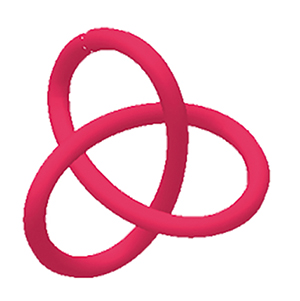
The trefoil knot is not a slice knot.
The question had been settled for every knot with fewer than thirteen crossings. Every knot? No! One lone knot continued stubbornly to resist mathematicians: an eleven-crossing knot proposed by John Conway in 1970.
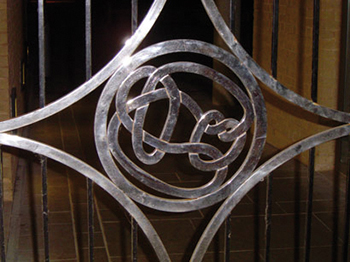
The Conway knot on a door in the Department of Mathematics at the University of Cambridge (Great Britain).
In 2018, Lisa Piccirillo, an American student from Maine, heard about the question. Approaching it with fresh eyes, she reduced the problem to the study of another knot and settled it in the negative… in just one week! Along the way, she introduced a new perspective that looks likely to prove fruitful. The Conway knot is therefore not a slice knot. This result made Lisa Piccirillo one of the very first recipients of the Maryam Mirzakhani New Frontiers Prize and helped her secure a position at MIT, just a few months after defending her thesis.