Tangente: First of all, could you tell us about your training?
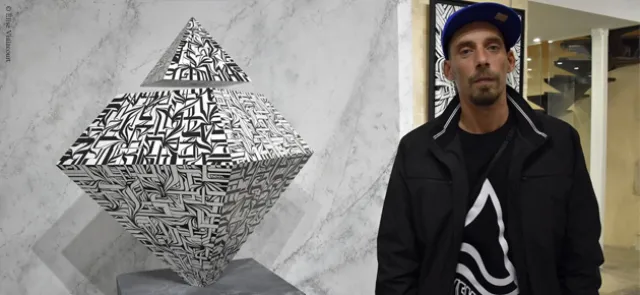
Michel Delaunay: After a scientific background (physics/chemistry), in 1973 I turned to artistic studies at the École régionale des beaux-arts de Rouen, since renamed École supérieure d’art et design Le Havre-Rouen (ESADHaR). My fascination with geometry led me to devote my thesis to Histoire des polyèdres (History of Polyhedra) — that is its actual title. As soon as I graduated, I joined the School as a teacher. From then on, I split my time between higher education and secondary teaching in middle school and high school, while continuing my artistic research.
Why did you turn toward mathematical art?
The starting point of my artistic practice lies simultaneously in a deep affinity for both polyhedra and mathematical thought. The teaching of geometry and perspective also played a central role in my training; these disciplines, which run through the history of Western art since the Renaissance, offer a common foundation for the various artistic fields in which form and space are shaped and questioned.
Studying Euclidean geometry, as it is used in pictorial representations of space, thus allowed me to deepen my understanding of an essential problem: the projection of three-dimensionality onto a flat surface — in other words, the illusion of depth in two dimensions.