What mathematics enthusiast has never succumbed to the arithmetical charms of magic squares? No doubt these centuries-old objects still fascinate us partly because their simplicity allows anyone, with or without a computer, to explore the world of these ancient companions of humankind. It is also partly because of the mysteries they hold. How many are there? How can we construct them all? What happens if constraints are added to or removed from their definition? The author has devoted several now-classic books to these questions [(les Carrés magiques, Vuibert, 2000; la Magie du carré, Vuibert, 2003; *le Carré naturel*, Nuvis, 2011).]
It all begins with an obvious observation: n2 distinct integers can be placed in the n2 cells of a square with n rows and n columns. If the n row sums and the n column sums can all be made equal, the result is a semimagic square. The integer n is called the order of the magic square. The common value S of these 2n sums is the square’s magic constant. If both diagonal sums are also equal to S, then the square is a magic square. Finally, if the n2 integers are precisely those from 1 to n2, the (semi)magic square is said to be normal, and its magic constant S must be
S*n = n (n*2 + 1)/2. Indeed, the sum of all the integers from 1 to n2 is n2 (n2 + 1)/2, and is also n × S*n*.
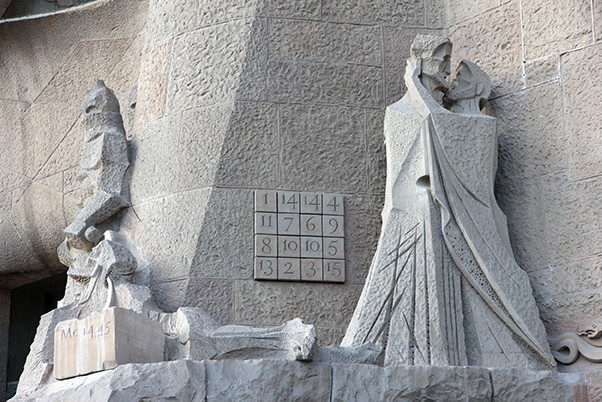
The Sagrada Família magic square (Barcelona, Spain).
The magic of permutations
----------------------