
In a paper published in 1931, statisticians Jerzy Neyman (1894–1981) and Egon Sharpe Pearson (1895–1980) laid the foundations for the study of hypothesis testing, introducing a formalism that is still used today, although it is increasingly criticized. In inferential statistics, a hypothesis test is used to make a decision about an (unknown) population parameter on the basis of a (known) estimate of that parameter from a random sample of the population (a classic example of such a test is given in the box).
To perform a statistical hypothesis test, we first formulate a basic (conservative) hypothesis about the population, called H0, together with an alternative hypothesis H1. We then draw a random sample from the population and calculate the statistic of interest for that sample. A decision rule then tells us whether the statistic observed in the sample is compatible with the hypothesis H0 about the population—or, more precisely, the extent to which the observed statistic is compatible with H0. An a priori probability calculation determines whether the observed result is likely or unlikely, given the hypothesis H0.
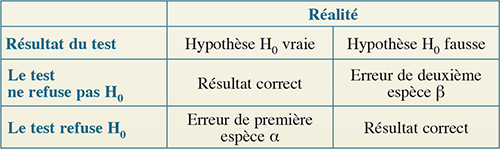
Possible errors
----------------------
A hypothesis test can produce four possible outcomes, depending on the true situation and the test's conclusion.