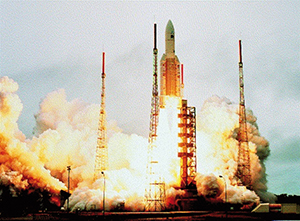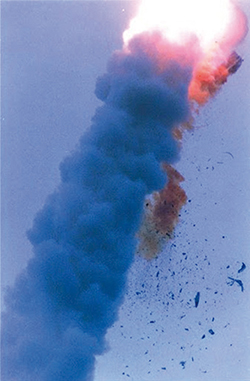
June 4, 1996, Kourou space center in French Guiana: the maiden flight of the Ariane 5 rocket. About thirty-seven seconds after liftoff, at an altitude of 4,000 meters, it explodes in mid-air, together with the satellites it is carrying. Cost: five hundred million dollars! A commission of inquiry was established, chaired by the mathematician Jacques-Louis Lions (1928–2001), who had been director of the CNES (Centre national d’études spatiales) from 1984 to 1992.
Its report, published a few weeks later, shed light on the cause of the problem. Essentially to save money, Ariane 5 used the same navigation software as Ariane 4, since it had worked perfectly well… for Ariane 4. But Ariane 5's horizontal acceleration could take values far higher than Ariane 4's. These values were converted into integers stored in a 16-bit memory register, which was too small to represent the values Ariane 5 could reach. This caused a representation error, which led to the failure of the navigation system and then the rocket's self-destruction…
In everyday life, the numbers we encounter are written in the decimal system. Thus, 431.75 equals 4 × 10² + 3 × 101 + 1 × 100 + 7 × 10⁻¹ + 5 × 10⁻². This notation requires ten symbols: our familiar digits from 0 to 9, of course. Using base 10 in computer hardware would require a physical system with ten clearly distinguishable states, and no such system currently exists. So how are numbers represented in a computer?