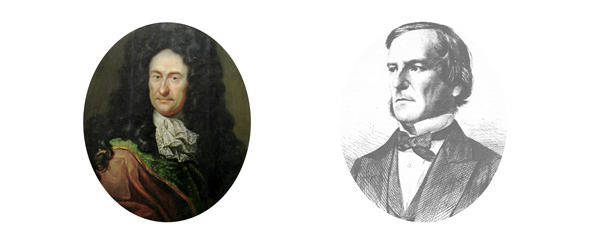
Gottfried Wilhelm Leibniz is best known in mathematics for his contribution to the development of differential and integral calculus in the 1670s. His talents, however, extended far beyond mathematics. He also produced important research in philosophy, philology and logic. This led him to explore the representation of numbers in a "minimal" base—base 2—which uses just two symbols: 0 and 1. Following his theoretical research in 1703 and that of the British mathematician George Boole in 1854, firm mathematical foundations established the binary system as a powerful means of representing data.
Just as the decimal system represents numbers using ten different digits (0, 1, 2, 3, 4, 5, 6, 7, 8 and 9), the binary system takes its name from the fact that each digit can have only two possible values: 0 or 1. A binary digit is called a bit, a contraction of the English term binary digit.
===========================