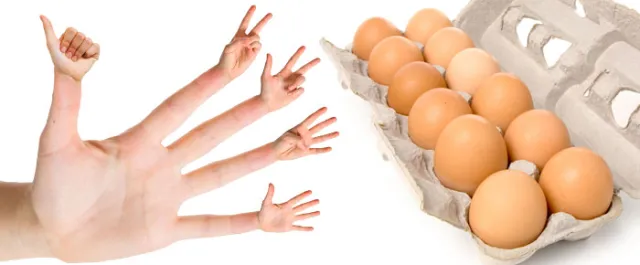
The vast majority of languages use base 10 to name numbers. In French, for example, "dix-sept" corresponds to 10 + 7, and "deux cent vingt-trois" to 2 × 100 + 20 + 3. This probably stems from our ten fingers, which our ancestors used for counting. A decimal relationship between a unit and a subunit has the enormous advantage that a quantity can immediately be expressed in a different unit. Thus, eleven kilometres equal eleven thousand metres. By contrast, converting your speed into kilometres per hour after travelling thirty-seven kilometres in forty-eight minutes is more difficult. You must multiply the quotient 37 / 48 by 60, giving 46.26 km/h.
Why 60? Obviously, because an hour contains sixty minutes. We inherited this convention from antiquity, particularly from the Sumerians and then the Babylonians (see In brief: *"Did you say 60...?"*), but it also appeared in Chinese and Indian civilizations well before the Common Era.
Why 12 and 60
---------------------
Our anatomy accounts for the choice of 10. Its drawback is that it is not a multiple of 3, so division by 3 produces results that are awkward to write as decimals. By contrast, 12 is divisible by 2, 3 and 4, while 60 is a multiple of both 10 and 12.