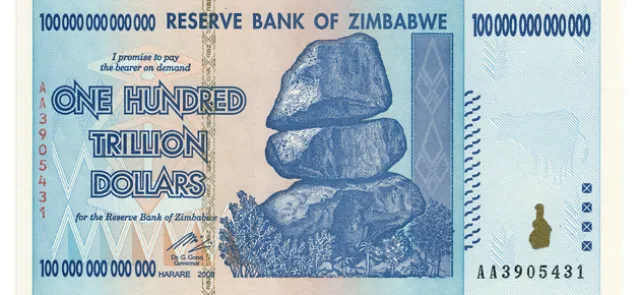
Scientific notation or separators?
----------------------------------------
Scientists generally write large numbers using powers of 10. For example, France's national debt is written not as €2,332,000,000,000 but as €2,332 × 109. This saves the tedious business of counting zeros! Such notation is useful only when the number ends in many zeros, as is the case for a measurement of a known physical quantity given to just a few significant figures. Should the speed of light be written as 299,792,458 m/s or 2.99792458 108 m/s? Scientific notation gives us an immediate idea of its order of magnitude. Traditional notation, however, is the easiest to say aloud.
In running text, writers are reluctant to use digits for a number, let alone use powers of 10. A mixed system is preferred, expressing the debt as "2,332 billion." The situation is different when an exact number is required—for example, France's debt to the nearest euro at time t (see dettepublique.fr), which stood at €2,332,798,169,265 when this article was written. It is impossible to take in at a glance unless its approximate value is already known.
To avoid these pitfalls, numbers are customarily divided into groups. They are generally grouped in threes, reflecting how numbers are named in most Western languages. In France, spaces are used, so 2,332 billion 798 million 169 thousand 265 is written 2 332 798 169 265. Unfortunately, the separator is not universal. The British prefer a comma, the Germans a full stop (or sometimes a space), and German-speaking Swiss generally an apostrophe...
Indian separators
-------------------
We owe our place-value numeral system to India, so numbers written in Hindi look entirely familiar, provided, of course, that we know the Devanagari digits. Rest assured that English, another official language, is also widely used, in which case "our" digits appear. The only difficulty is that, even in the English-language press, separators are not always placed every three digits, making large numbers hard to read. This stems from the way numbers are named in Hindi!
Like French, Hindi does have a word for "thousand," but beyond that, powers of 10 are named in increments of two: "one hundred thousand" is lakh, while "ten million" is crore. There is, however, no specific word for "one million," which is called das lakh, or "ten hundred-thousands"; the notation naturally follows this usage. India's population stands at 1,36,74,22,465 (see countrymeters.info), so France's debt is written €23,32,80,40,26,935: difficult to read, but you will have gathered that it has risen by nearly six million euros since the sidebar opposite was written!
China's ancient system
------------------------------
The Chinese use a numeral system that follows their language exactly. As in French, they have a specific word for each number from 1 to 10. To say 48, they say sì shí b?, or "four ten eight," and likewise write ? ? ?, using in turn the terms meaning four, ten and eight. The accents denote the tones (falling, rising; level; and falling then rising).
This pattern continues, with a word and symbol for hundred (b?i ?), thousand (qi?n ?) and ten thousand (wàn ?). Beyond that, the Chinese group terms in fours rather than threes as we do. For this purpose, yì denotes 108 (not to be confused with y?, meaning 1), while zhào means 1012. Thus, 482,356 is said as "48 ten-thousands 2,356," or ? ? ? ? ? ? ? ? ? ? ?, read sì shí b? wàn èr qi?n s?n b?i w? shí liù.
Ancient though it is, the Chinese system is very simple, but large numbers become difficult to read. As for France's debt, it has risen by nearly another ten million, reaching
?? ???????? ???????? ??????? euros!