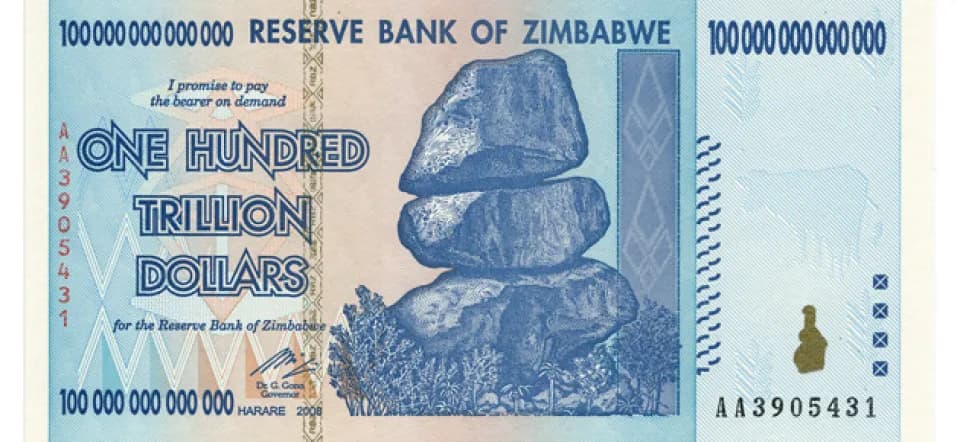
In November 2024, a famous American business magazine ran the headline "Will Elon Musk become the world’s first trillionaire?" on the French-language page of its website. References to trillions are fairly rare in the press. Most of us remember that the English equivalent of the French milliard is billion. But trillion is an unfamiliar word. What does that mean for future trillionaires? Unless, of course, the fortune is denominated in Zimbabwean dollars. Amid hyperinflation, the Reserve Bank of Zimbabwe issued a "One hundred trillion dollars" banknote in 2009 before suspending the local currency while the country’s economy recovered.
To better understand this seldom-used vocabulary, it helps to explore how large numbers are named, from the short scale to Chuquet's long scale, and from John Conway's zillions to the myriads of Archimedes and Donald Knuth—a journey through language and mathematics.
Long and short scales: two ways of naming powers of 10
This is not merely a matter of translation. The Anglo-American world uses billion for milliard chiefly because two different systems are used to name large numbers, the first of which emerged in the 15th century. We owe the terms long scale and short scale to Geneviève Guitel—one of the first women to pass the agrégation in mathematics, in 1920—who used them for these systems in her Histoire comparée des numérations écrites (Flammarion, 1975). Today, the long scale is used mainly in continental Europe and in French-, German- and Spanish-speaking countries. The short scale is used in most English- and Arabic-speaking countries, as well as in the countries of the former Soviet Union.
France, for example, currently uses the long scale: million corresponds to , billion to and trillion to . The United States uses the short scale: million still denotes , but billion is and trillion is . More generally, on this scale, the number is called an N-illion. Although decimal notation divides numbers into groups of three digits in both systems, the short scale introduces a new term for each power of 1,000, whereas the long scale uses powers of 1,000,000. Some languages that use the long scale have words ending in “-iard” for the intermediate numbers. In French, milliard means one thousand million. In France, however, billiard, trilliard and subsequent terms are not accepted by the Académie française.