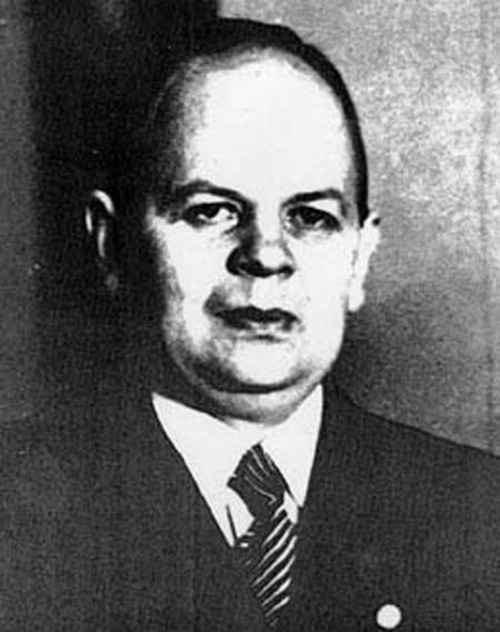
Wilhelm Ackermann (1896–1962).

With a surprisingly simple definition, the Ackermann–Péter function generates numbers of a staggering size. This mathematical construction, born out of research into computability, shows how quickly a recursive procedure can exceed all the usual bounds.


Articles recommended for you.

When it comes to representing extremely large numbers, the standard operations, including exponentiation, are no longer enough. With considerable imagination, Donald Knuth and John Conway devised notations to overcome this limitation.

The various types of loops are fundamental programming constructs. Although using them often comes naturally, they nevertheless raise a number of issues, such as whether the program will ever stop. Recursion offers useful solutions.

Many mathematicians have lent their names to numbers in common use. "Very large" numbers have names too: a way had to be found to represent them as well, since they come up in several fields, from combinatorics to mathematical logic!

Writing a computer program is one thing. Proving that it actually produces the expected result is another! One major advantage of recursion is that it produces programs whose correctness is easy to prove. There is a link between writing a program and proving it correct.
Discussion
Sign in to post a comment and talk with other readers.
No comments yet. Be the first to respond.