Chinese is probably one of the easiest languages in which to learn to count, since its numeral system is strictly decimal. Here is how the numbers are pronounced in Mandarin:
| 0 | 1 | 2 | 3 | 4 | 5 | 6 | 7 | 8 | 9 | 10 |
|---|---|---|---|---|---|---|---|---|---|---|
| ling | yi | er | san | si | wu | liu | qi | ba | jiu | shi |
Numbers up to 99 can be formed using these ten words. For example, 20 is pronounced er shi , literally "two-ten", while 69 is liu shi jiu , or "six-ten-nine". To go beyond 100, you need only learn the following words:
| 10 2 | 10 3 | 10 4 | 10 8 | 10 12 | 10 16 |
|---|---|---|---|---|---|
| bai | qian | wan | yi | zhao | jing |
Thus, 6918 is pronounced liu qian jiu bai shi ba .
For larger numbers, the Chinese group digits in fours, rather than in threes as we do. They therefore need a word for every 10 4 * n * , and 345 6918 is expressed as 345 × 10 4 + 6918, pronounced san bai si shi wi wan liu qian jiu bai shi ba . B. H.
Two contemporary numeral systems
---------------------------------
Today, numbers can be written in two ways: the "small-form" numeral system (xiaoxie ), which is relatively simple and used in everyday life, and the "large-form" numeral system (daxie ), whose complexity makes it harder to falsify, hence its use in financial transactions—for example, on cheques, just as we write amounts out in full. The latter was devised under Empress Wu Zetian (reigned 690–705) and later revised under Hongwu (reigned 1368–1398). Here is how the numbers whose pronunciations were given above are written in these two traditions:


The scholarly numeral system
-----------------------
Chinese mathematicians used bamboo rods to represent numbers, rather like the pebbles of Greek (psephoi) or Roman (calculi) antiquity. Vertical and horizontal rods were used alternately to avoid any ambiguity about place value; two successive groups of parallel rods indicated a blank place—in fact, an odd number of "zeros", so to speak! This notation, known as "counting rods" (suanchou), is attested from the 1st century BC (and probably existed as early as the 3rd century BC), roughly a thousand years before the earliest surviving evidence of the Indian numeral system!
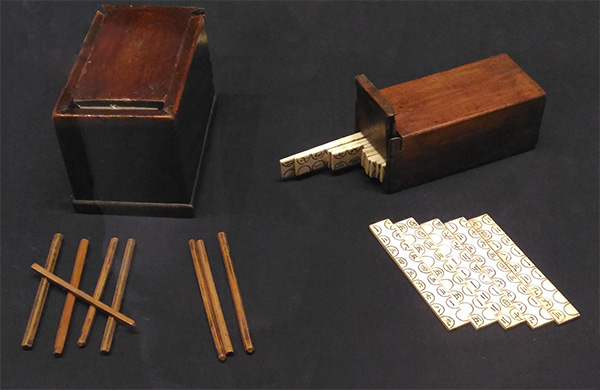
Counting rods, National Folk Museum of Korea.
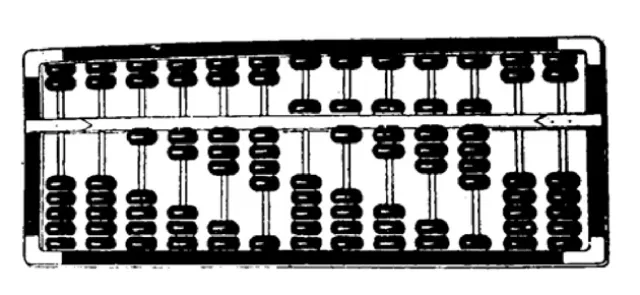
For practical reasons, this system naturally evolved into a system of beads, the forerunner of the abacus. Although the rods themselves have disappeared, written counting-rod notation can still be found in Chinese texts.

For example, the number 1906 is written

with a blank space indicating that there are no tens. F. L.