We often hear and read the peremptory judgment that ancient Chinese mathematics lacked proof: supposedly, only algorithmic procedures were to be found there. Such a claim is nuanced by the work of the historian Jean-Claude Martzloff. According to him, the absence of explicit traces of proof in ancient texts does not necessarily mean it did not exist; it could result from a fragmentary transmission or from writing conventions that changed over time. The ancient mathematical texts we read in Chinese are not necessarily entirely faithful to the way they were originally written (see the article "Sources and variety of so-called Chinese mathematics"). As for the specific issue of proof in the sense in which we understand it in the West, it is a notion imported by the Jesuits in the 16th century, and one that was already familiar to the Greeks. In the Meno, Socrates uses the verb δείκνυμι (deiknumi, "to show"), which in Euclid would come to mean to demonstrate.
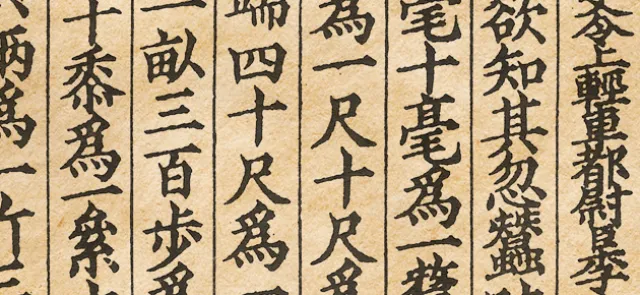
We must therefore undertake a work of textual archaeology on sources predating the arrival of the Jesuits, as Paul Pelliot (1878–1945) did when he unearthed, from the caves of Dunhuang (in what is now northwestern China), unknown texts, or versions older and closer to the original manuscript than those that later served as references. Some texts were lost, at least for a time, such as The Nine Chapters on the Mathematical Art (Jiuzhang Suanshu, see the article "The Nine Chapters, a foundational work"): we know, for example, that in the 16th century, the mathematician Cheng Dawei (1533–1606) tirelessly wandered, riding his donkey, through the Nanjing region in search of a fragment of the text, or of a scholar who might reveal to him a few scraps he recalled from the work. In the end, it was the Japanese who, during a raid on Korea, brought back in their spoils this priceless treasure: the complete text of the Nine Chapters, thus restored to the Chinese tradition.
Regarding the very notion of proof (in the sense derived from Greek mathematics), let's draw a parallel from the work Sophia: Philosophie et phénoménologie by the philosopher Alexandre Kojève (1902–1968). There he explains that as long as the airplane existed only as a project, its hypothesis could be studied, but that once the airplane was built, the hypothesis became integrated into reality itself and transformed it.
Formal mathematical proof as conceived in the West, which was integrated into Chinese reality only once the Jesuits introduced and used it in the 16th century, seems to play exactly the role of Kojève's airplane in the history of Chinese mathematics. Yet, appealing as this parallel is, it runs up against the radical otherness of China.
Monstration and demonstration
----------------------------