Against a backdrop of continuity that sets it apart (see the article "Why be interested in the history of mathematics in China?"), the advancement of science in China followed much the same dynamic as everywhere else: assuming that the surviving texts offer a faithful reflection of the facts, we find periods of intense scientific activity, marked by remarkable innovations, and periods that left few notable works in this respect, or even periods during which earlier scientific achievements seem to have become a dead letter. It was in the context of one of these periods, when many earlier scientific advances had been forgotten, that closer scientific relations between China and Europe began at the end of the 16th century — relations that were to contribute to building what we know today as the "international scientific community".
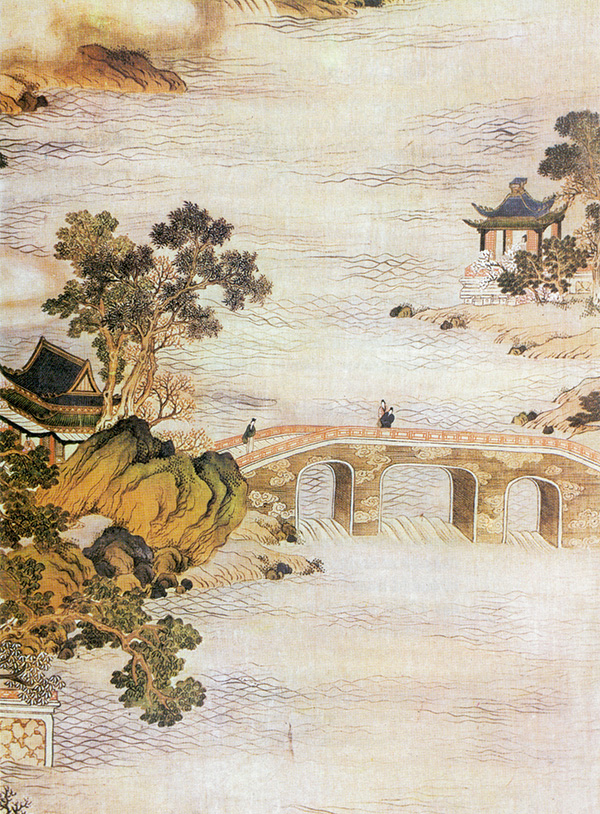
A 16th-century painting depicting a landscape with a bridge.
The arrival of the Jesuits in China…
---------------------------------
The introduction into China of sciences from Europe, from the end of the 16th century up to the dawn of the 19th century, was due mainly to a strategy devised by European Jesuits to serve the needs of their missionary activities. They decided, first of all, to take advantage of the curiosity and interest that their scientific and technical knowledge aroused among high-ranking Chinese officials, in order to obtain the right to enter China. There, unlike members of other religious orders, they set about making themselves useful to those in power through their scientific activities, and to that end dispensed the knowledge they had acquired in Europe during their studies in Jesuit colleges. Having understood the full benefit to be gained from such knowledge, they chose to exploit it more systematically and brought over from Europe learned Jesuits, books and instruments. Their motivations for engaging in science and technology were rooted, in more than one way, in their religious aims: to maintain themselves in China by making themselves indispensable, so as to be able to carry out their evangelizing activities there, but also to assert the superiority of their religion by invoking the excellence of "their" science, by virtue of various parallels drawn between the Christian religion and so-called "Western science". Chinese scholars thus gained access to scientific knowledge developed or preserved in Europe in a very specific context, which shaped the process of its introduction in several ways.