



The foundational texts
China represents the center of East Asian mathematics because its continued geopolitical power and its script used by other civilizations enabled all mathematical corpus written in Chinese to be read, adapted and deepened over the centuries. The texts that have come down to us are nevertheless not very numerous and are the consequence of the choices of successive dynasties. If the most famous – and oldest – treatise is The Nine Chapters, many other works have developed very advanced, original research and sometimes ahead of what was being done in Europe at the same time. Nevertheless, the so-called Chinese mathematics do not present themselves as a unity: that is where things become interesting!
All articles in this folder
 Podcast
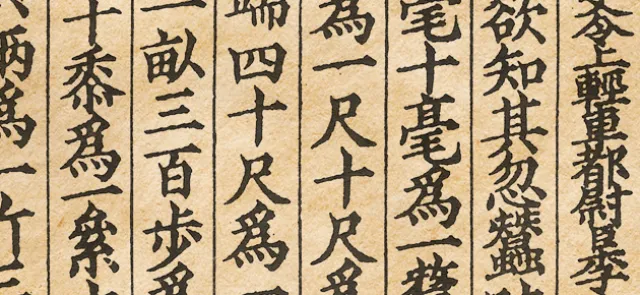
Sources and variety of Chinese mathematics | Tangente
Surprisingly few ancient mathematical works survive from China. This can partly be seen as the result of political choices made by successive dynasties. It helps us understand that the history of mathematics is neither linear nor made up of homogeneous cultural blocks.
 Podcast
The Nine Chapters, a foundational work
The Nine Chapters on the Mathematical Procedures is a collection of problems, each chapter unified by a common procedure for solving them. Their mathematical interest lies chiefly in the commentaries and elaborations of Liu Hui, their principal commentator.
 Podcast
The Book of Changes and Leibniz's binary system | Tangente
The Book of Changes is a seminal work in the history of Chinese thought and has notably influenced several mathematical texts. Its interest in permutations explains its importance.
 Podcast
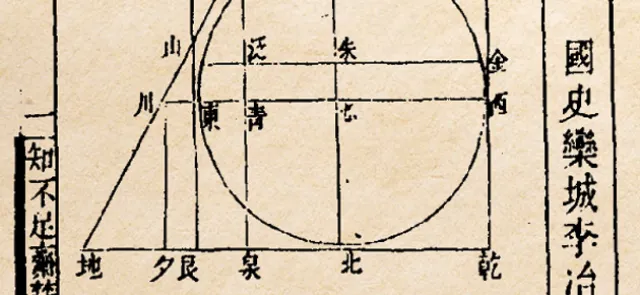
The math quartet of the Song-Yuan dynasties | Tangente
The period covered by the two Song dynasties and the early Yuan dynasty was particularly conducive to mathematics. Indeed, four great names emerged during this time: Li Ye, Zhu Shijie, Qin Jiushao, and Yang Hui. Their works share common influences but sometimes very different approaches.
 Podcast
Chinese science history: an awakening interest | Tangente
At the end of the sixteenth century, contact with knowledge and practices from Europe changed the way mathematics was perceived in China, both from a technical and a historical point of view, around two major questions: how should it be practiced, and who invented it first?