During the four centuries of the Han dynasty (206 BC to AD 220), a determination emerged to build up a body of knowledge for the centuries to come, very little of which has reached us (see the article "Sources and variety of so-called Chinese mathematics"). It was only in 1984 that the Book of Mathematical Procedures (Suanshushu) was discovered, predating the Nine Chapters (Jiuzhang Suanshu) by several decades. It is a manuscript devoted mainly to administrative management. Another reference work from the same period is the Gnomon of the Zhou ( Zhoubi Suanjing), which deals with mathematics related to the calendar, surveying and astronomy. These two treatises represent the two components that make up the treatise of the Nine Chapters, and were chosen to be part of a set of ten texts, the Ten Classics of Mathematics, intended to serve as mathematics textbooks for state education. In all these works, knowledge of the algorithms for the basic operations (+, -, ×, /) is assumed for a positional, decimal representation of the integers (see the article "Counting in Chinese"). The version we have is enriched by Liu Hui's valuable commentary, written in 263.
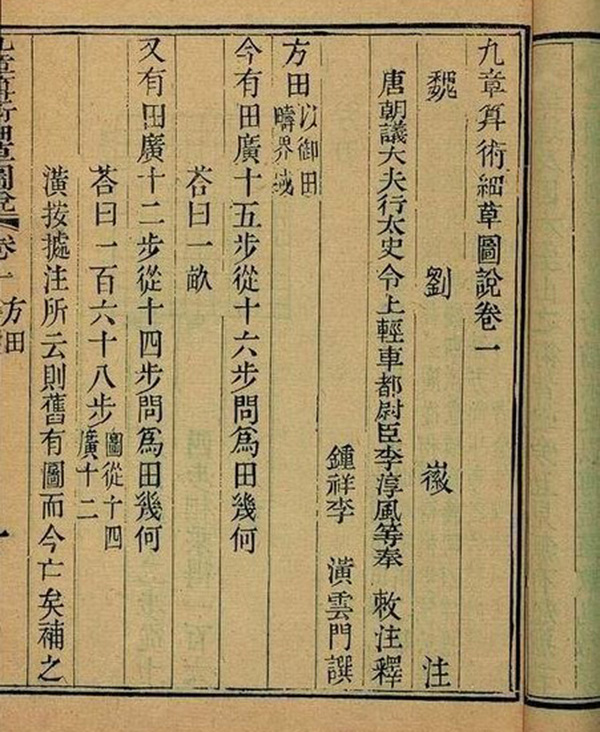
An edition of the Nine Chapters dating from 1820.
Contents of the work
-------------------------
The Nine Chapters is a compilation of 246 problems, dated from around 100 BC to AD 100, grouped by a common solving procedure into nine distinct chapters. The examples given are, in a sense, instances of a particular type of problem.