The best-known method for polynomial equations is the celestial source (tian yuan), a phrase that refers to the four active entities of Taoism: heaven (tian), earth (di), man (ren) and things (wu), which name four unknowns. The word yuan, used to denote the unknown, which means "source" or "origin," is also the name of the intersection at the center of Go game boards. We know that these boards were also used for divination, although we have only a few clues about how they were used.
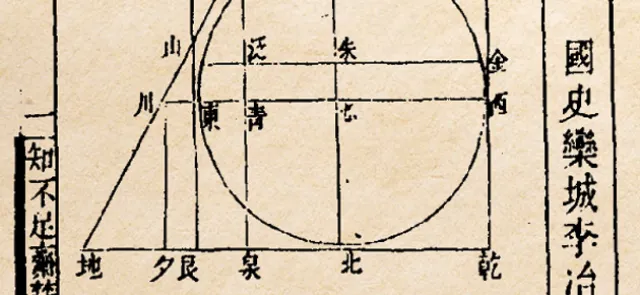
This procedure is described and extensively used by Li Ye in his Sea Mirror of Circle Measurements (Ceyuan Haijing, 1248) and his Development of Pieces [of Areas] from Ancient [Procedures] (Yigu Yanduan, 1259), as well as by Zhu Shijie in Precious Mirror of the Four Unknowns (Siyuan Yujian, 1303). It is this last work, moreover, that allowed the method to be imported into Japan during the 17th century, where the Chinese school of algebra is called tengen (written the same way as in Chinese but pronounced differently), in direct reference to the Chinese phrase tian yuan.
This procedure, forgotten and then rediscovered by Mei Wending (1633-1721), would become the emblem of so-called "traditional" or "Chinese" mathematics, to the point that the other, older procedures unjustly fell into the shadows. In the Development, the practitioner works with superimposed areas. These areas are transformed, cut up, moved, and recombined by means of an imagined visualization in order to reveal the quadratic equation. This procedure is called the area-sectioning procedure (tiao duan). It is the ancestor of the celestial source procedure. Here we see a whole body of exploratory work on the coefficients of the quadratic equation, in particular on negative coefficients. The problem is a substantial one: how can a negative coefficient be thought of geometrically; what is an empty area? Li Ye added the tian yuan procedure to this older method to clarify and generalize the geometric process. As the method was generalized, the geometric representation eventually disappeared, no longer being necessary.
The celestial source in Li Ye's work
-----------------------------