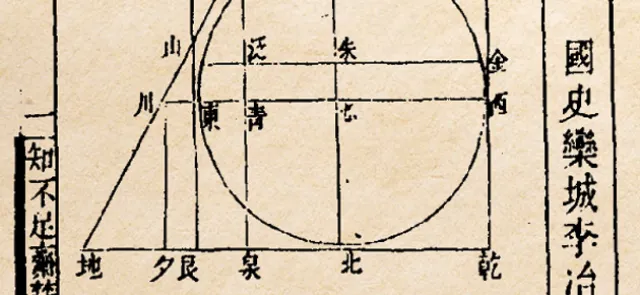
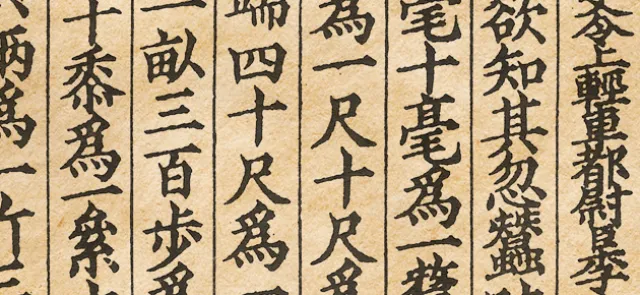
On the one hand, among the treatises written under the Song and Yuan dynasties (see the article "The Mathematical Quartet of the Song Dynasties"), the Sea Mirror of Circle Measurements (1248), the Jade Mirror of the Four Unknowns (1303), and the Mathematical Treatise in Nine Sections (Shushu Jiuzhang, 1247) are often praised for their highly developed mathematical knowledge and theories and their complex practical aspects (see the article "Establishing Polynomial Equations"). On the other hand, the popularization of practical mathematical knowledge and practices stands out in the context of the development of the social economy of this period.
Concise formulas for arithmetic
------------------------------------------
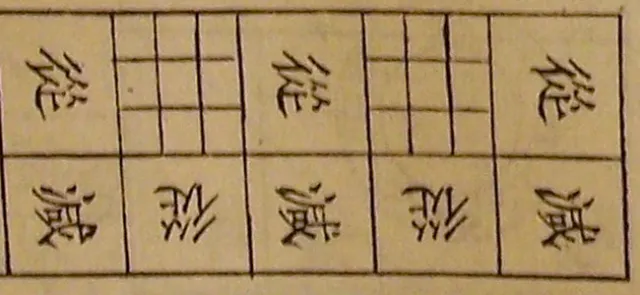
The earliest surviving evidence of fast methods of multiplication and division is found in a book titled Xiahou Yang's Mathematical Classic. Specialists disagree on when this work was completed, but most suggest it is the work of Han Yan (active in the 8th century). Based on the text concerning the use of counting rods (see the article "Counting in Chinese") in Master Sun's Mathematical Classic, which was included among the Ten Mathematical Canons of the 7th century, historians suggest that at that time, when practitioners performed multiplications or divisions with counting rods, the numbers were arranged in three rows. For example, the two operands of a multiplication were arranged on the top row and the bottom row respectively, and the result of the multiplication was placed on the middle row. As for division, the dividend (shi) was arranged on the middle row, the divisor (fa) on the bottom row, and the resulting quotient was placed on the top row.
The pursuit of speed and convenience in calculation may have led to the continuous development of fast methods of multiplication and division over the following four hundred years. A representative work that systematically presents various fast methods of multiplication and division is titled Yang Hui's Mathematical Methods (1274–1275).
Alongside these fast calculation methods, a large number of rhymed concise formulas (a term we use here for a short mnemonic phrase) appear in the books produced during this period. This way of setting mathematical content down as concise formulas is found in mathematical works such as the Introduction to Mathematical Studies (Suanxue Qimeng, 1299), the Jade Mirror of the Four Unknowns, the Great Compendium of Mathematical Methods for the Nine Chapters, with Analogies (Jiuzhang suanfa bilei daquan, 1450, hereafter referred to as the Great Compendium), and the Precious Mirror of Mathematical Studies (Suanxue Baojian, 1524).