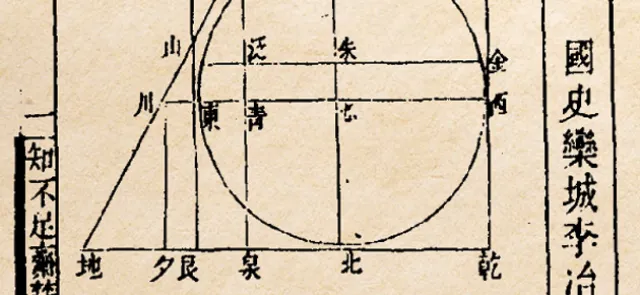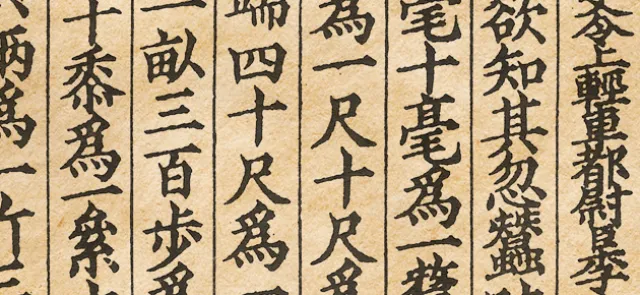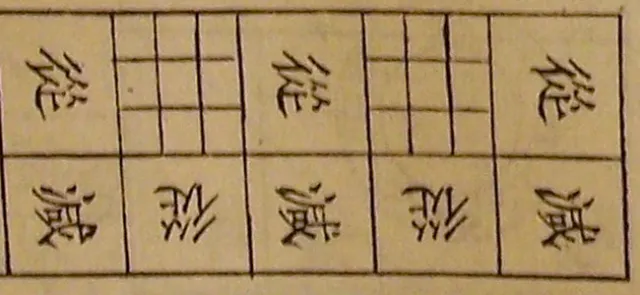




D’un côté, parmi les traités écrits sous les dynasties Song et Yuan (voir l'article « Le quatuor mathématique des dynasties Song »), Lemiroir de la mer de la mesure du cercle (1248), Le miroir de jade des quatre éléments (1303), et l’Écrit sur les mathématiques en neuf chapitres, (Shushu Jiuzhang, 1247) sont souvent loués pour leurs connaissances et théories mathématiques très développées et leurs aspects pratiques complexes (voir l'article « Établir des équations polynomiales »). D’un autre côté, cependant, la popularisation des connaissances et des pratiques mathématiques pratiques se démarque dans le contexte du développement de l’économie sociale de cette période.
Les formules concises pour l’arithmétique
Les premiers indices subsistants de méthodes rapides de multiplication et de division se trouvent dans un livre intitulé Le classique mathématique de Xiahou Yang. Les spécialistes ont des avis différents sur la date d’achèvement de cet ouvrage, mais la plupart suggèrent qu’il serait l’œuvre de Han Yan (actif au VIIIe siècle). En se basant sur le texte concernant l’utilisation des baguettes à calculer (voir l'article « Compter en chinois ») dans Le classique mathématique de Maître Sun, qui était compris parmi les Dix canons des mathématiques du VIIe siècle, les historiens suggèrent qu’à cette époque, lorsque les praticiens effectuaient des multiplications ou des divisions avec des baguettes à calculer, les nombres étaient disposés sur trois rangées. Par exemple, les deux opérandes d’une multiplication sont disposés respectivement sur la rangée du haut et celle du bas, et le résultat de la multiplication est placé sur la rangée du milieu. Quant à la division, le dividende (shi) est disposé sur la rangée du milieu, le diviseur (fa) sur la rangée du bas, et le quotient obtenu est placé sur la rangée du haut.
La recherche de la rapidité et de la commodité dans le calcul a pu conduire à un développement continu de méthodes rapides de multiplication et de division au cours des quatre cents années suivantes. Un ouvrage représentatif qui présente systématiquement différentes méthodes rapides de multiplication et de division s’intitule Les méthodes mathématiques de Yang Hui (1274-1275).
Parallèlement aux méthodes de calcul rapides, un grand nombre de formules concises (on désignera ainsi une petite phrase mémotechnique) rimées apparaissent dans les livres produits durant cette période. La manière de rédiger le contenu mathématique sous forme de formules concises se retrouve dans des ouvrages mathématiques comme l’Introduction aux études mathématiques (Suanxue Qimeng, 1299), le Miroir de jade des quatre éléments, le Grand compendium des Neuf chapitres sur les méthodes mathématiques avec analogies (Jiuzhang suanfa bilei daquan, 1450, appelé, dans la suite de ce texte, Grandcompendium), ou encore le Miroir précieux des études mathématiques (Suanxue Baojian, 1524).