The equations of modern physics
This issue is not fully translated into English yet; only translated content is shown.
Read the French versionAll folders in this issue



Relativity
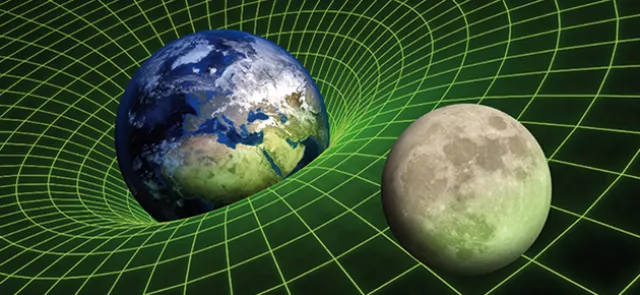
The arrival of relativistic theories imagined by Albert Einstein at the beginning of the 20th century overturned our understanding of the universe. The equations of the new model hold their share of mathematical surprises, and therefore of fascination. Gravity becomes a manifestation of geometry, non-Euclidean spaces impose themselves, the formation of theoretical singularities suggests the discovery of black holes and other very concrete objects, tensors impose new formalisms… A new world, where cosmology is based on mathematics, enriches itself day by day and it is far from having revealed all its secrets!


Quantum mechanics
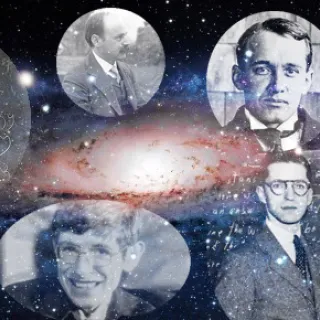
The relativistic revolution had already dealt a blow to Newtonian theories. The case seemed settled: physicists finally had "the great universal theory" that would allow them to methodically explore the universe, from the infinitely large to the infinitely small. The infinitely large, perhaps! But the subatomic world still obstinately refuses to submit to classical laws. New theories reign supreme in these realms. Mathematics was called upon to come to the rescue in order to express, formalize and explain the many phenomena, counter-intuitive to our senses and our scales, that occur in quantum mechanics.


The questions are still open!
Most physical theories were imagined abstractly before being (or not) validated, sometimes a long time after, by observations. Even today, explorations continue and propose new visions of our world, which will one day be confirmed or disproved. It is often daring mathematicians who have ventured into what is apparently not their territory, although the two disciplines were very close until the last century. Yet, who better than these adventurers of abstract concepts can uncover a hidden law? Among them, a woman, Emmy Noether, knew how to base a part of physics on the research and study of invariants, thus becoming a pioneer of modern mathematical physics. Some of David Hilbert's celebrated problems are also in connection with physics.