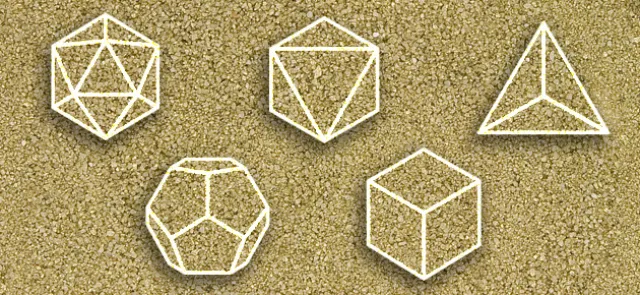
In the Timaeus, Plato uses them to explain how a demiurge brings the universe out of primordial chaos and into being.
During the Renaissance, Plato came back into favor. Kepler pondered the arrangement of the six known planets. He found the solution: each orb was separated from the next by a Platonic solid! He later disproved his theory when he discovered elliptical orbits.
Today, astrophysicists are still asking the same questions: is the universe finite? What is its topology? After analyzing data from the WMAP probe, which measures the cosmic microwave background, they concluded that the universe might be finite and that Poincaré's dodecahedral space could provide a "good" topological model for it. But the more precise results from the Planck probe do not support this hypothesis…
The dodecahedron and its dual, the icosahedron, also appear in the recent "theory of everything" (see the box "The elusive theory of everything" in the article "Indispensable symmetry groups"), which involves the group E8. Pierre-Philippe Dechant's research has shown that this group is already implicit in the icosahedron.
Could the Platonic solids be shadows of more fundamental mathematical objects, such as their symmetry groups? And what, in turn, are those groups themselves shadows of?