Two identical doughnuts… but not really
Imagine two objects you can examine from every angle, measure every which way, probe into their smallest nooks and crannies — and which seem absolutely, rigorously identical. Yet they are fundamentally different. Not because of a measurement error, not because you missed something: simply because the difference between them is invisible to any local observation. This scenario, which sounds like a philosophical sleight of hand, has just been proven mathematically. And it took 150 years to get there.
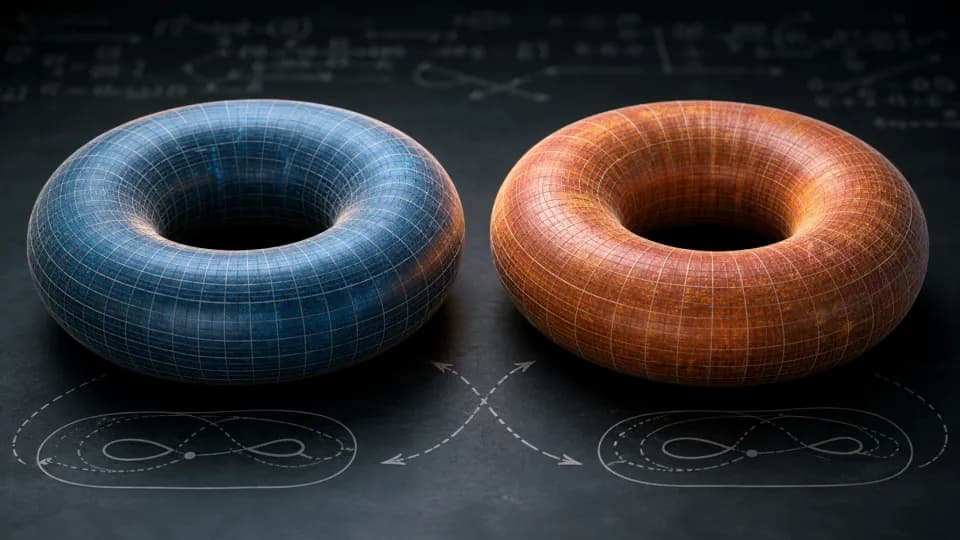
Mathematicians have proven the existence of two torus-shaped surfaces — the technical name for the doughnut, that ring shape geometers love — that are locally indistinguishable but globally different. A distinction that sounds abstract, yet it calls into question a rule accepted since the days when mathematicians still wore frock coats.
The torus, star of topology
Before going any further, a short detour is in order. In mathematics, a torus is a surface that resembles the surface of a doughnut: it is closed, has no boundary, and has a hole at its center. It is one of the shapes most studied in topology, the branch of mathematics concerned with the overall shape of objects — not their precise measurements, but their structure as a whole. In topology, a coffee cup and a doughnut are "the same thing" (both have exactly one hole), but a doughnut and a sphere are radically different.
As for geometry, it is concerned with measurements: distances, angles, curvatures. And this is where things get interesting. When we talk about local measurements, we mean what a tiny inhabitant living on the surface could observe around itself, without ever seeing the overall shape. Much like us on Earth: at the human scale, the ground seems flat, even though the Earth is a sphere.
The 150-year rule: the local determines the global
Since the second half of the 19th century, one principle had reigned supreme in the geometry of surfaces: if two surfaces have the same local properties everywhere — that is, if they are locally identical at every point — then they are globally identical, or at least very similar. This principle, rooted in the founding work of Bernhard Riemann and his successors, gave mathematicians a powerful tool: to understand the shape of a space, it was, in theory, enough to take a local inventory of it.
In practical terms, this meant that if two surfaces "looked" like the same thing from the inside — if a tiny inhabitant could never tell one from the other through measurements of distances or curvatures — then they had to be, at bottom, the same surface (up to a few transformations). It was reassuring. It was elegant. And it was, as we have just learned, wrong.
Two doughnuts that look alike… but aren't
The new proof establishes the existence of two tori that satisfy exactly the same local geometry at every point — the same curvature, the same distances, the same measurable structure at every finite scale — but that are topologically distinct. In other words, no continuous deformation (without tearing or gluing) can turn one into the other. They differ in their global essence, even though no local measurement can reveal it.
"Locally identical" does not mean "globally identical." That is the lesson geometry has just learned the hard way.
To grasp how strange this is, picture two mazes. Every corridor, every intersection, every wall is identical in both mazes: the same width, the same height, the same angles. A blind explorer, who can only feel their footsteps and touch the walls, could never tell them apart. Yet the overall structure of the two mazes is different — one has an exit on the right, the other on the left, or one loops in a way the other does not. That is exactly what mathematicians have built, but for curved surfaces in several dimensions.
Decades of suspicion
This result did not come out of nowhere. For decades, several mathematicians had suspected that such objects must exist. Partial examples, limiting cases, and approximate constructions had fed the collective intuition. But rigorous proof was missing — and in mathematics, intuition is not enough. What is needed is a proof, complete and watertight.
The difficulty lay in the very nature of the problem: building two geometric objects that are locally identical demands an extremely fine command of the equations governing the curvature of surfaces. The local resemblance must be perfect at every point, not just at a few well-chosen spots. It is an exercise of formidable precision, drawing on tools from differential geometry, analysis, and algebraic topology.
What this changes — and what it opens up
The consequences of this discovery go well beyond the particular case of tori. It raises a fundamental question for the whole of geometry: in what situations do local measurements suffice to characterize a global space? And in what situations are they misleading?
For mathematicians working on the classification of manifolds — the grand project of cataloguing and distinguishing every possible shape in the mathematical universe — this result forces a rethink of certain strategies. Methods that implicitly relied on the idea that "locally the same = globally the same" must now be reconsidered.
There are also more far-reaching implications, in fields such as theoretical physics, where the geometry of space-time lies at the heart of the models. If the universe is a high-dimensional manifold, the fact that its local properties do not determine its global structure is not a purely academic question. It bears on whether we could, in principle, deduce the shape of the universe from local observations — which is, in a sense, what we do with cosmological measurements.
Concepts to take away
For math enthusiasts
In Riemannian geometry, a Riemannian manifold is a space (a surface, a volume, or a generalization in any dimension) equipped with a metric — that is, a way of measuring distances and angles at each point. Two Riemannian manifolds are said to be locally isometric if, for every point of one, there exists a neighborhood that can be "glued" onto a neighborhood of the other so as to preserve all distances. In other words, a tiny inhabitant could not distinguish the two spaces by any measurement made within an arbitrarily small neighborhood.
The classic question was: are two compact, locally isometric manifolds necessarily globally isometric (or at least isometric up to a covering)? The new result answers no, by constructing two tori — 2-dimensional compact manifolds without boundary — that are locally isometric at every point but are not homeomorphic (and so a fortiori not isometric) as global topological spaces. The construction draws on techniques from Riemannian coverings and spectral analysis, exploiting the fact that the spectrum of the Laplacian does not always determine the manifold — an echo of the famous problem "Can you hear the shape of a drum?" posed by Mark Kac in 1966.