Let's begin our journey through space with a black hole. This celestial object is so compact that the strength of its gravitational field prevents any form of matter from escaping. When two black holes collide and merge, the resulting black hole has a greater surface area than the two original black holes combined. Furthermore, the entropy of a system, which characterizes the unpredictability of its information content, increases over time. This suggests that a black hole's entropy is proportional to its surface area. This raises another question: what is the temperature of a black hole?
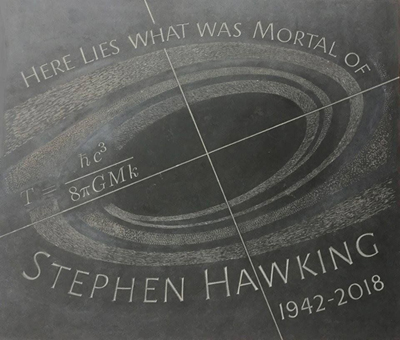
=
Black holes radiate
======================================================================
Because quantum vacuum fluctuations give rise to particle–antiparticle pairs, Stephen Hawking (1942–2018) proposed a phenomenon known as evaporation: the tidal forces generated by a black hole's gravitational field pull the particle away from its antiparticle before they can annihilate each other. The black hole's temperature is therefore given by the formula engraved on the theoretical physicist and cosmologist's gravestone. And like any body with entropy, the black hole really does "radiate."