The equations of general relativity (see box) rank among the most fundamental equations in all of modern physics. Introduced in 1915 and 1916 by Albert Einstein (1879–1955), they are now known more simply, in the singular, as Einstein's field equation. It presents countless formidable mathematical challenges of great beauty (the hoop conjecture, nonlinear stability of the Kerr family, the BKL conjecture…), including the famous conjectures concerning cosmic censorship (see below): the equation is still far from having revealed all its secrets!
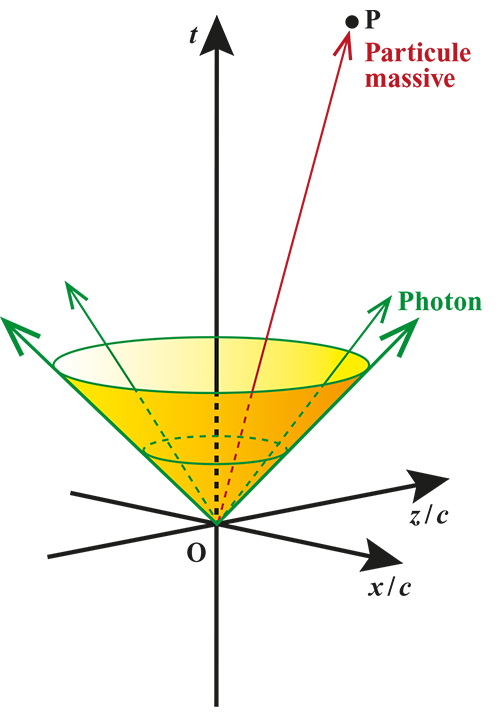
Mathematically, a "spacetime" is a Lorentzian manifold equipped with a metric. The "shortest path" between two points of the manifold, with respect to the metric in question, is called a geodesic. The "curvature" of the spacetime under consideration is encoded and quantified by a curvature tensor (here, R*μ*,*ν). The more "curved" spacetime is, the more rapidly its geodesics diverge or converge. Finally, if gμ*,*ν(V) > 0, the tangent vector V is spacelike; if gμ*,*ν(V) = 0, it is lightlike; and if gμ*,*ν(V) < 0, V is timelike*.