One of the great mathematical developments of the Renaissance was the introduction of perspective. This revolution arose, among other things, from the convergence of several concerns and technical advances: the availability of copies of Euclid's Elements, the foundation of geometry; a flourishing of the arts; the desire to reconcile Plato, an immensely fashionable author during the Renaissance, with artistic representation; and the advent of large panes of glass and stained glass.
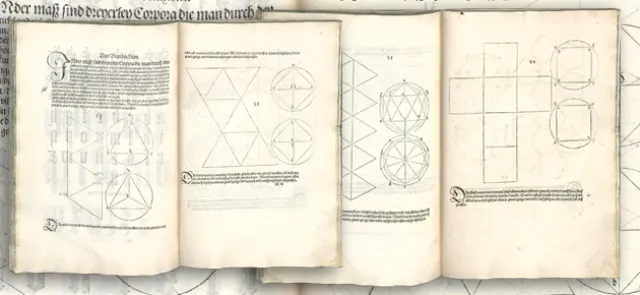
Since Euclid's Elements also dealt with polyhedra, their study resumed, and people even began drawing and reproducing them. One craft of the period played a part: intarsia. This involved marquetry panels depicting—in perspective, of course—what the panel was supposed to conceal. To display their virtuosity, craftsmen portrayed polyhedra, initially those in the Elements and later more sophisticated objects. In the woodworking shops, these same craftsmen must also have tried to construct the polyhedra physically, to check that their drawings were accurate. One of the leading figures of the period was Piero della Francesca, who wrote the first treatises on perspective—and on polyhedra as well. Unfortunately, none were published during his lifetime.
-
The geometry behind it
-----------------------
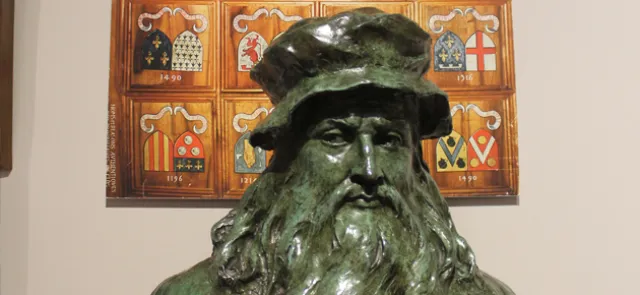
The greatest mathematician of the age was probably the monk Luca Pacioli. In 1494, he published his masterpiece in Venice: Summa de arithmetica, geometria, proportioni et proportionalita. In 1496, Ludovico Sforza, Duke of Milan, invited him to Milan to teach mathematics in the palace schools. There he met Leonardo da Vinci and taught him geometry, giving him access to Euclid's Elements, since Leonardo had a poor command of Latin. The two men became friends and left together for Mantua in 1499. But while in Milan, between 1496 and 1498, Pacioli composed the celebrated De divina proportione, which was not published until 1509 in Venice.