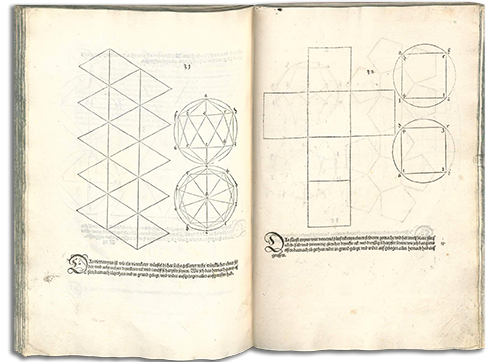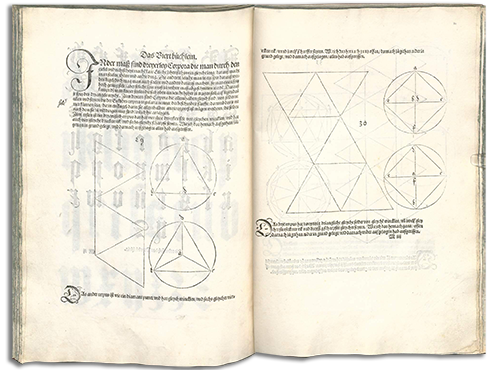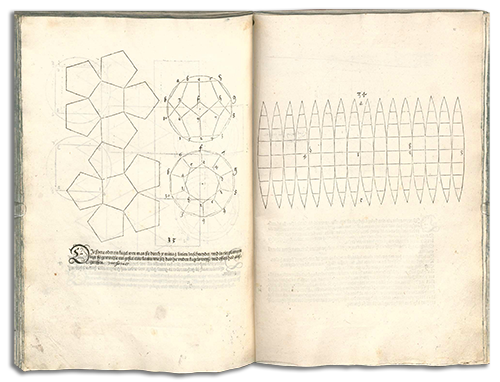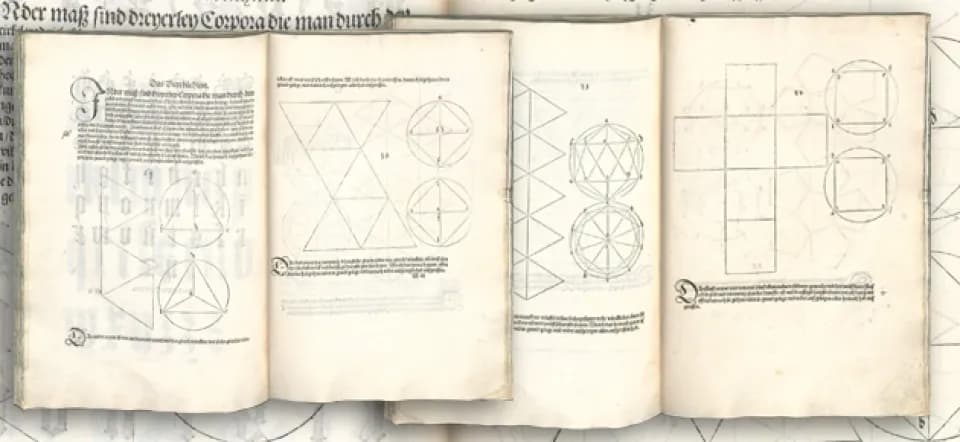
Albrecht Dürer (1471–1528) is known worldwide as a painter, but less so as a mathematician. His book Instructions pour mesurer à la règle et au compas is practical above all. He examines how to measure solid figures and, in order to draw them more accurately, studies their projections onto two perpendicular planes (see les Secrets des dimensions, Bibliothèque Tangente 66, 2019). He was also fascinated by polyhedra, as some of his paintings attest.
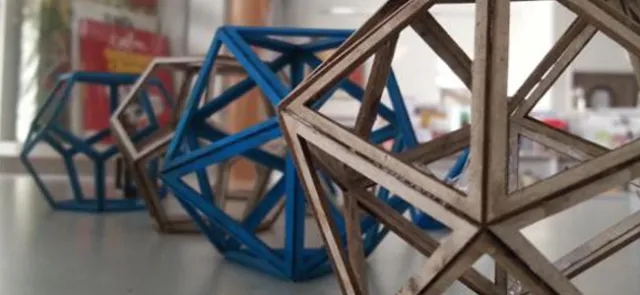
Does every polyhedron have a net? This question is known in the literature as Dürer's problem. What is a net? A net is the surface of a polyhedron that has been cut along a number of edges and then unfolded to cover part of the plane without any overlap. The "unfolding" uses the edges as hinges. Conversely, cutting out a portion of the plane, folding it along edges and joining the free edges may produce a polyhedron—or it may not. In some cases, faces may overlap when laid flat. This never happens with the examples given to primary-school pupils, but try it with your dodecahedron: there is a strong chance that two faces will overlap once unfolded into the plane.