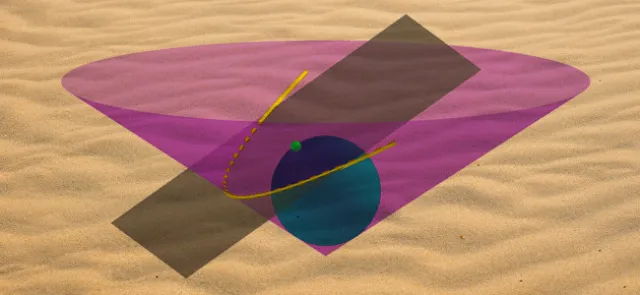
The invention of technical drawing is attributed to Piero della Francesca (c. 1415–1492), who is thought to have laid its foundations in his De prospectiva pingendi. Yet Albrecht Dürer seems to have been the first to use a technique resembling modern technical drawing to obtain mathematical results. He did so in his Underweysung der Messung mit dem Zirckel und Richtscheyt (Instructions for measuring lines, planes, and solid bodies with ruler and compass), published in 1525, notably to construct conic sections by intersecting a right circular cone with a plane. Dürer's method can be reconstructed from his drawing using descriptive geometry.
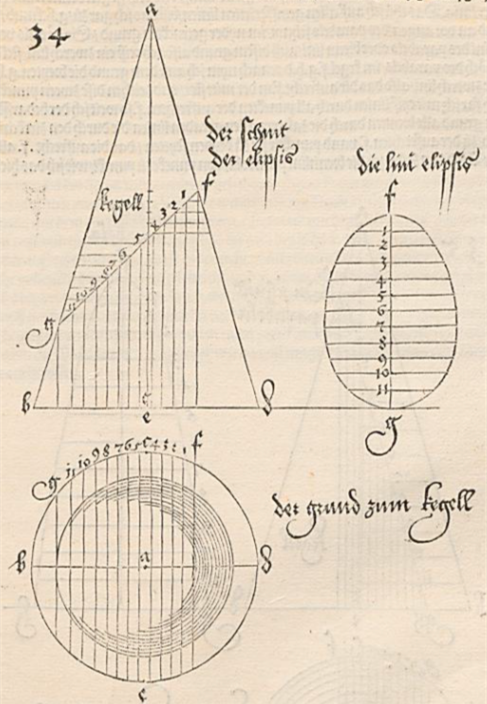
Albrecht Dürer's construction of an ellipse.
A little descriptive geometry...
-----------------------------
Descriptive geometry would later be formalized by Gaspard Monge. It provides the theoretical foundation for technical drawing (see Les Secrets des dimensions (The Secrets of Dimensions), Bibliothèque Tangente 66, 2019). Descriptive geometry uses two orthogonal projection planes: the horizontal plane and the frontal plane. The frontal plane shows the front view, while the horizontal plane shows the top view (see box).