



Two instruments in history
Two instruments, the unmarked ruler and the compass, came to the fore from Antiquity. They materialized the first axioms of Euclidean geometry and allowed its array of challenges to spread through space and time. They gave rise to a myriad of construction techniques and mathematical tricks, also exploited by artists whose drawings produced wonders. Beyond the alliance of these two mythical tools, spectacular results were achieved with only one of the two.
All articles in this folder
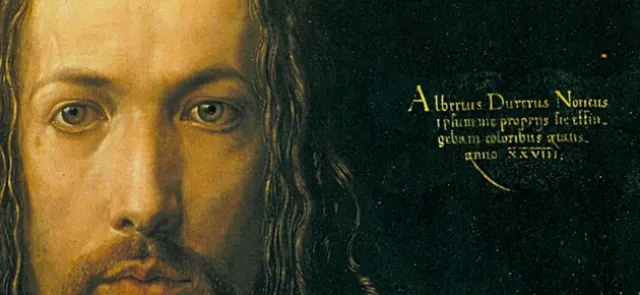
Albrecht Dürer and technical drawing | Tangente
Albrecht Dürer (1471–1528) devised a fascinating straightedge-and-compass construction of the ellipse. It foreshadowed descriptive geometry, which Gaspard Monge (1746–1818) would formalize almost three centuries later.
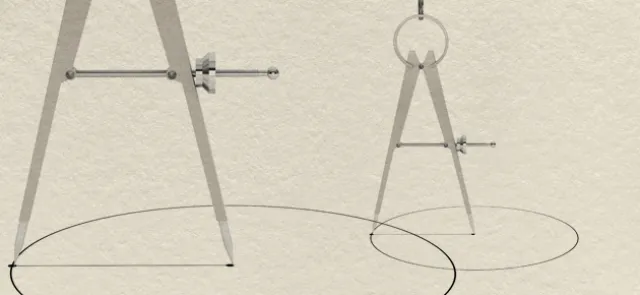
When the compass won't follow the ruler
A famous result in geometry, still surprising when first encountered, states that any point in the plane constructible with straightedge and compass can be constructed with a compass alone. But how is this actually done?
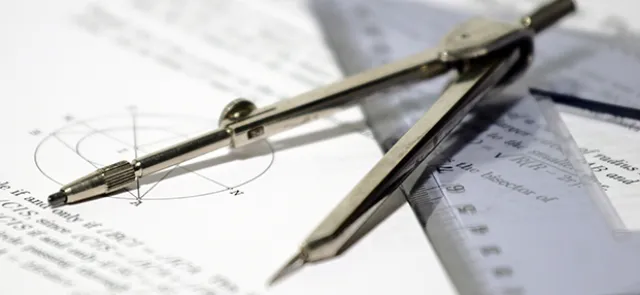
With a straightedge alone... or almost
According to the Poncelet–Steiner theorem, every straightedge-and-compass construction can be carried out with a straightedge alone, provided that a fixed circle and its center are given. But how is this done in practice? Though the question may seem playful or even pointless, it has in fact attracted the attention of several mathematicians.
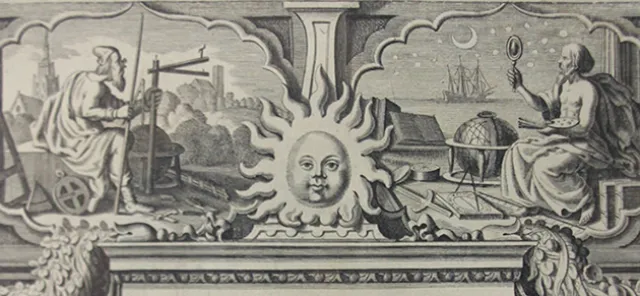
Through Euclid's eyes
Two postulates in Euclid's Elements embody the ideal conception of the straightedge and compass inherited from Plato's realm of Ideas. The Alexandrian scholar built much of plane geometry—and the constructions he bequeathed to us—on these two postulates.

Give Euclid his due...
Geometric constructions are central to reasoning in Euclid's The Elements. The various methods of teaching geometry, right up to the present day, claim to follow this approach.

Compass: a universal instrument | Tangente
Compasses are made of wood or metal, in all sizes, with or without a sector.