Precision instruments
----------------------------
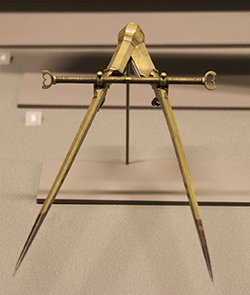
The most common type is the hinged compass, whose two legs pivot about a hinge. A compass's sector is a circular arc attached to one leg that slides through the other (if the arc is a quarter-circle, the instrument is called a quarter-circle compass). It allows the compass to be locked at particular openings, while graduations can be used to determine angles and proportions. If the legs are straight, it is a straight-leg compass; otherwise, it is a curved-leg compass. A compass whose two legs end in points is known as a pair of dividers. A precision instrument, it is used not only to draw circles but also to compare and transfer distances.
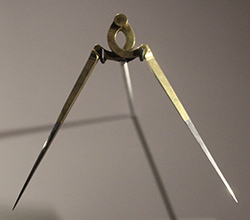
Dividers.