A model of rigor
--------------------
The geometrical books of Euclid's Elements can be read as a model of axiomatic-deductive rigor, but also as a work devoted to constructions using intersections of lines and circles. These two types of curve are considered perfect because they are "homeomerous" (uniform), and the first three axioms of Book I call for drawing and extending a line and describing a circle. The propositions are either theorems, ending with "what was to be proved," or construction problems, ending with "what was to be done." Theorems and problems are intertwined: a theorem must be stated in relation to a constructed figure, while a construction must be justified by a proof based on theorems. The importance of constructions—their relationship to knowledge, and hence to teaching—continued over the following centuries, as knowledge was gradually organized (see the article "Straightedge and compass in education").
Theorem 8 as a construction tool
-----------------------------------------
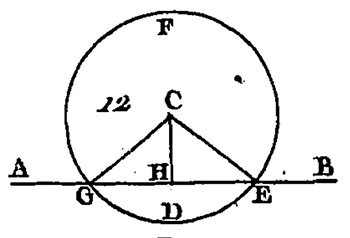
In Euclid's Elements, Theorem 8 states that two triangles with equal corresponding sides are congruent (that is, they can be superimposed). This result is used to justify several constructions: constructing an angle bisector, finding the midpoint of a line segment, and drawing a perpendicular to line AB through a point C outside the line. A line is said to be perpendicular to another line if it intersects it so that the adjacent angles are equal. Euclid gives the construction without comment: D is chosen on the other side of line AB; the circle with center C and radius CD is drawn; [EG] is bisected at H; and [CG], [CH] and [CE] are joined. He proves that triangles CHG and CHE are congruent, and hence that angles and are equal.