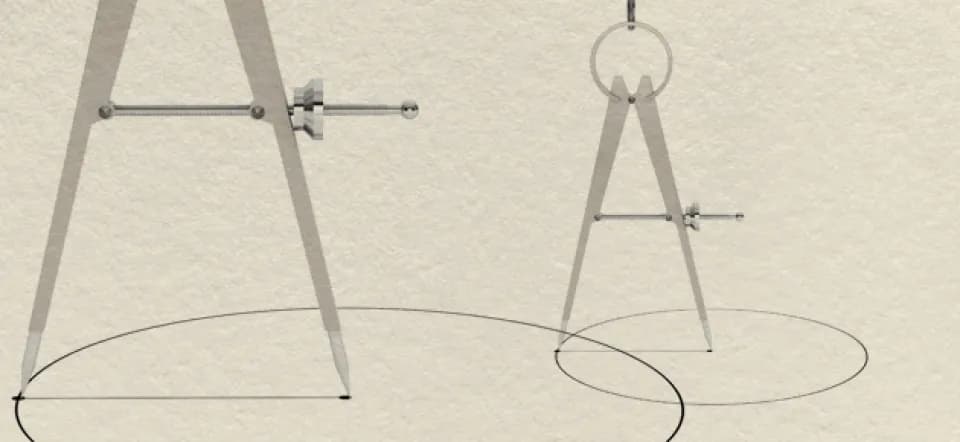
During the Italian campaign, Napoleon Bonaparte (1769–1821) met the Italian geometer Lorenzo Mascheroni (1750–1800), then teaching at the University of Pavia. His best-known work was Geometria del compasso ("the geometry of the compass"), published in 1797 and dedicated to Bonaparte. The book's main result is that any construction performed with straightedge and compass can be carried out with a compass alone—that is, without a straightedge. Of course, this does not mean that one can draw a line using only a compass; rather, every point on a line that can be constructed with a straightedge and compass can itself be constructed with a compass alone.
Nearly a century later, in Denmark, the geometer Johannes Trolle Hjelmslev (1873–1950) arranged for the 1928 republication of Euclides Danicus, a work he had found in a second-hand bookshop. It had vanished after its first publication in 1672, in both Danish and Dutch. Its author, the Dane Georg Mohr (1640–1697), had in fact anticipated Mascheroni's result by more than 150 years!
A surprising result!
------------------------
The Mohr–Mascheroni result is surprising. Since all Euclidean constructions use straightedge and compass, the challenge is to reproduce every one of Euclid's constructions with a compass alone, as elegantly as possible—that is, with as few steps as possible. In fact, it is enough to show that the following can be constructed with a compass alone (see the box for a few elementary constructions that will prove very useful):
• The intersection points of two circles specified by their centers and radii (this is trivial);