This issue is not fully translated into English yet; only translated content is shown.
Read the French versionAll folders in this issue

Two instruments in history
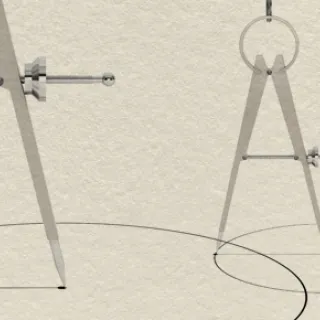
Two instruments, the unmarked ruler and the compass, came to the fore from Antiquity. They materialized the first axioms of Euclidean geometry and allowed its array of challenges to spread through space and time. They gave rise to a myriad of construction techniques and mathematical tricks, also exploited by artists whose drawings produced wonders. Beyond the alliance of these two mythical tools, spectacular results were achieved with only one of the two.
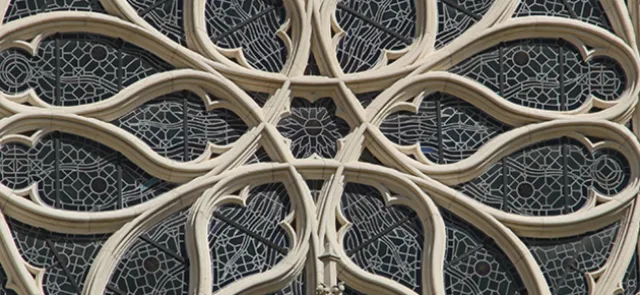
Geometric Constructions
After the basic geometric shapes, more elaborate objects were subjected to the action of the ruler and compass. Can we obtain ellipses or parabolas point by point and reconstruct all their notable points? We enter the universe of constructible numbers... or not. Finding which ones are is quite an art. The power of the techniques developed has invaded number theory and made it possible to resolve — in the negative — a problem more than two thousand years old: the quadrature of the circle!
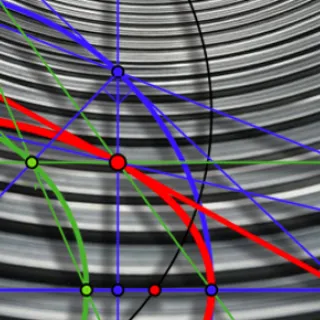

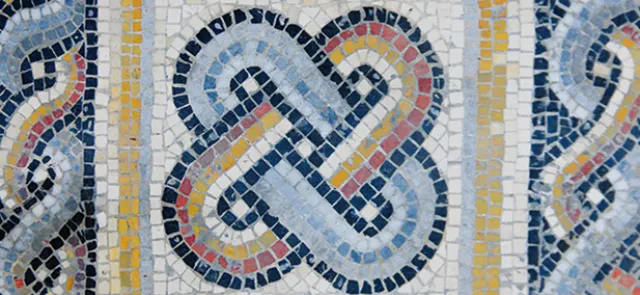
Practices of yesterday and today
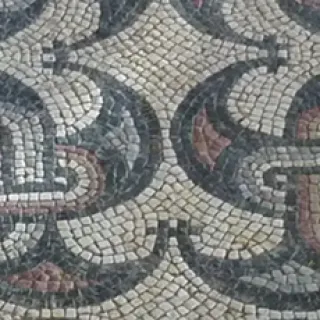
Redoubling ingenuity, the artisans of mosaics adorning the monuments of the Roman Empire, the builders of the Middle Ages or the designers of sangaku, these astonishing Japanese tablets, have widely used the two favorite instruments. But this is also the case (virtually) of today's dynamic geometry software, which always meet the same needs: copying lengths and connecting points. As for the very recent mathematical theory of origamis, it relies on... the absence of a ruler and compass, but the properties of lines and circles are still just as present!