In elementary geometry, we quickly become interested in the set of points equidistant from two given points A and B: this is the perpendicular bisector of segment [AB]. No sooner is this notion defined than we hasten to state the theorem that the perpendicular bisector is the line perpendicular to (AB) passing through the midpoint of [AB].
We almost as quickly introduce the set of points equidistant from two lines, or rather from two rays with the same origin S, which corresponds to the angle bisector of the angular sector thus defined. (In practice, we usually start from the opposite point of view, beginning by defining the notion of the bisector of an angle and then proving that it is the set of points equidistant from its two sides.)
Points equidistant from two points, points equidistant from two lines... a fairly natural way of looking for something new is then to turn to points equidistant from a point and a line. This is where the parabola appears.
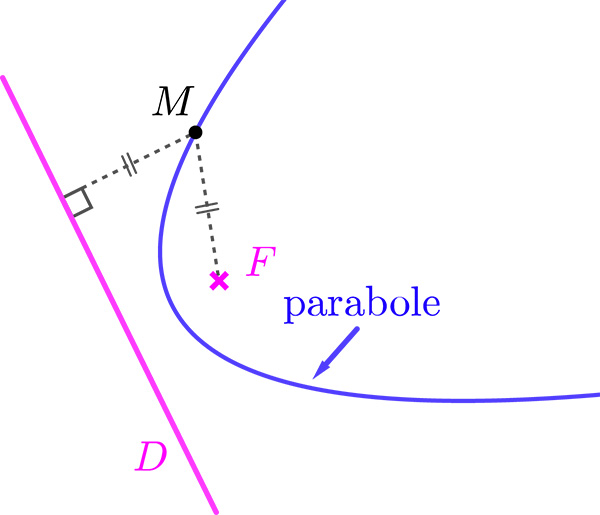
By definition, given a point F and a line D, the parabola with focus F and directrix D is the set of points M in the plane such that MF = d(M, D), where the right-hand side of the equality denotes the distance from point M to the line D.