
Ellipses are the easiest to find, since any planet—or asteroid—will do, by Kepler’s first law. Hyperbolas are rarer, but in principle they can still be found. We must look for extrasolar objects entering our neighborhood so fast that, despite its size, the Sun cannot hold them in its grasp. The first such object, ’Oumuamua—yes, the apostrophe is part of its Hawaiian name—was not observed until 2017.
Bodies that trace a parabola, however, are theoretically extremely rare and may even be impossible to find if we are being rigorous, since the parabola marks the theoretical boundary between the ellipse and the hyperbola. This makes it as difficult to observe as, say, two circles with exactly the same radius.
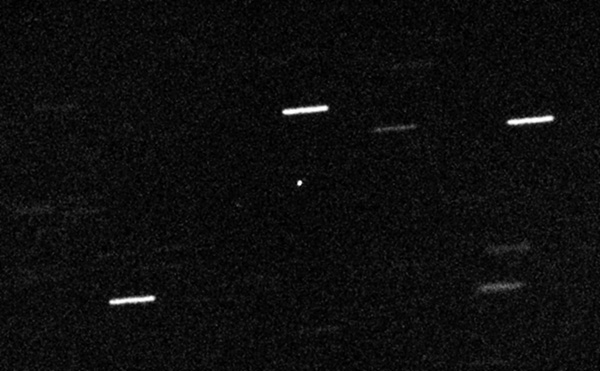
The interstellar object ’Oumuamua (center),
photographed on October 28, 2017, at La Palma in the Canary Islands.