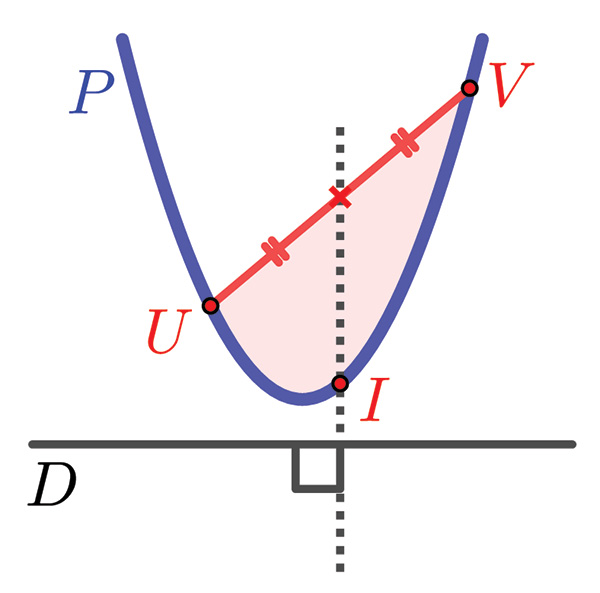
In the 3rd century BCE, Archimedes poses the following question: given two points U and V on a parabola P, what is the area of the surface bounded by P and the line segment [UV ]?
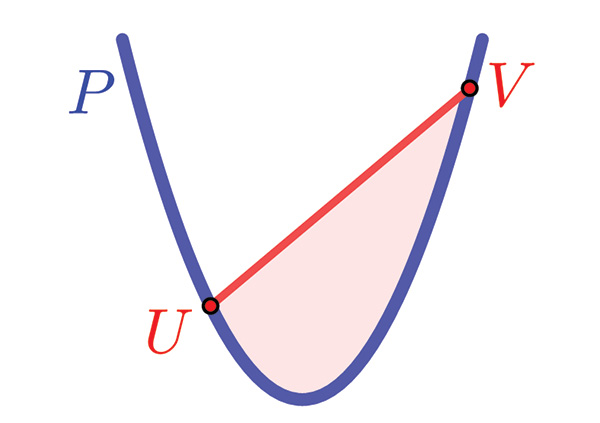
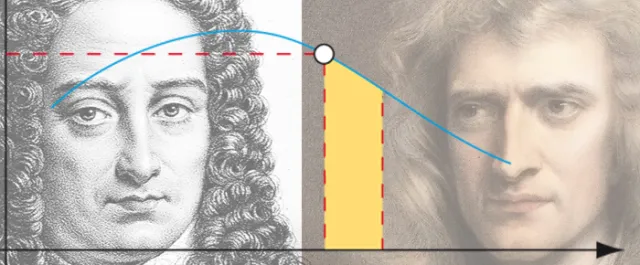
Nowadays, the question tends instead to be framed "the other way around", that is, to focus on the area below the parabola (by introducing suitable line segments), but it is easy to see that the two versions are fundamentally equivalent.
In antiquity, geometry did not use the notion of a coordinate system so common today, and the very idea that a parabola could be seen not as a line but as the graph of a function was nowhere on the agenda. Mathematical proofs therefore had to find paths that strike us as fairly complex, yet are not without elegance, and sometimes even provide an opportunity to bring to light some unexpected properties. The main one of these, for a quadrature of the parabola "the ancient way", is as follows. Given a parabola P, let us call the point I = m(U, V ), obtained by projecting the midpoint of [UV] onto P perpendicularly to D (the directrix of P), the parabolic midpoint of two points U and V on P (this name is not standard; we introduce it here for lack of an established term). Equivalently, taking P to be the graph of the function f defined by f(x) = x 2 and setting U = (u ; u 2 ) and V = (v ; v 2 ), we get I = ((u + v)/2 ; ((u + v)/2) 2 ).