As long as we confine ourselves to rectangles and triangles, the notion of area is elementary. By decomposing polygons into triangles, we can also define their areas easily, which would seem a priori to let us approximate the area of any region in the plane. In fact, not at all! The matter is more complicated: we must distinguish regions that have an area, known as quadrable regions, from those that do not (see le Calcul intégral, Bibliothèque Tangente 50). Here, however, we shall restrict ourselves to quadrable regions. Their essential property is that area is additive. More precisely, if two regions intersect in a set of zero area, as lines do, then the area of their union is equal to the sum of their areas.
The area under the curve
------------------------------
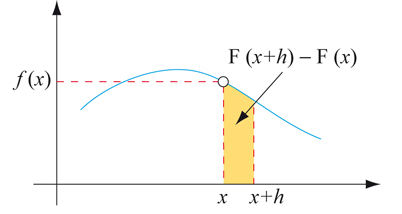
Suppose f is continuous (and positive) on an interval I, and that the region under the curve with equation y = f(x) between the x-coordinates a and x has an area, denoted by F(x). By additivity, the area under the curve between the x-coordinates x and x + h is then F(x + h) – F(x). If h is small, this region can be approximated by a rectangle of width h and height f(x), giving
F(x + h) – F(x) ≈ h f (x).