Johannes Kepler's (1571–1630) famous law of equal areas states that planets sweep out equal areas in equal times. It is generally illustrated with a diagram such as this one.
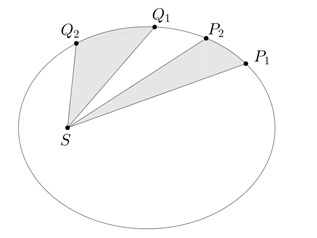
In this diagram, the point S represents the Sun. The area swept out by the planet between the points P1 and P2 is the area of the region bounded by the line segments SP1 and SP2 and by the arc of the orbit between P1 and P2. The law of equal areas says that if the planet takes the same time t to travel from P1 to P2 as it does to travel from Q1 to Q2, then the regions SP1P2 and SQ1Q2 have equal areas. This spectacular law profoundly changed the prevailing idea of the "celestial order." By giving the Sun a pre-eminent place at the expense of the Earth, it also helped dislodge our planet from the central position it had occupied in ancient descriptions of the cosmos.
A tour de force
--------------------
Kepler himself did not prove the laws that bear his name; he merely stated them on the basis of the observations available to him. Nearly a century passed before Isaac Newton provided a proof.