Using integral calculus to calculate areas is a well-established technique, as the previous article illustrates. The fundamental theorem of calculus, which connects the search for antiderivatives with the calculation of definite integrals, very often provides an elegant solution to problems of this kind. But not always! Calculating the area of a circle, for instance, proves particularly cumbersome in Cartesian coordinates; switching to polar coordinates then brings considerable elegance and practical benefits. And that is not all. This transformation also makes it possible to solve problems involving the integration of functions regarded as non-integrable in Cartesian coordinates…
Long live trigonometry!
---------------------------
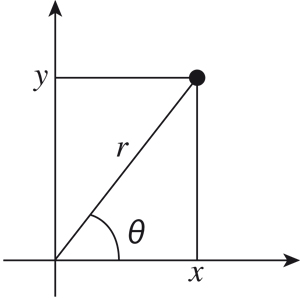
In a polar coordinate system, a point with Cartesian coordinates (x, y) is specified by joining it to the origin and measuring both the angle θ (in \0, 2XXLATEXPROTECTEDXX0XX\[) between this line segment and the horizontal axis, and the distance r > 0 from the point to the origin. The conversion formulas are x = r cosθ and y = r sinθ.
How can we calculate the area S of a circle C with radius R? In Cartesian coordinates, we integrate the constant function 1 over a region representing a circle (or a quarter-circle):