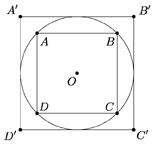
The area S of a disk of radius r is given by the famous formula . Calculating the area of the unit disk (r = 1) therefore amounts to determining the value of . Thus, whenever we approximate the unit disk by a geometric shape whose area can be calculated explicitly, we obtain an estimate of ; the "closer" the shape is to the disk, the more accurate the estimate. With squares, for example, we can proceed as shown below.
The area of ABCD is therefore less than , while that of A'B'C'D' is greater than . Since A'B' is equal to 2 (it is the diameter of the circle), the area of A'B'C'D' is equal to 4, and hence < 4. Furthermore, the diagonal AC of the square ABCD is a diameter of the circle, so AC = 2. In a square, the ratio of the diagonal to the side is , so the side length of ABCD is , that is, . It follows that the area of ABCD is . We therefore end up with the inequalities .
We have seen more accurate estimates... But given how poorly the squares hug the circle, we could hardly have expected much better! Another idea is to consider perimeters. After all, appears not only in the area of a disk but also in its circumference, through the formula . The circumference of the unit circle is therefore . If we accept—something slightly less obvious than the corresponding claim for areas—that the perimeters of the squares also provide bounds for the circumference of the circle, a short calculation yields , and hence . This is a little better than the estimate obtained from the areas, but we are not quite there yet...
A few more decimal places...
-------------------------------------