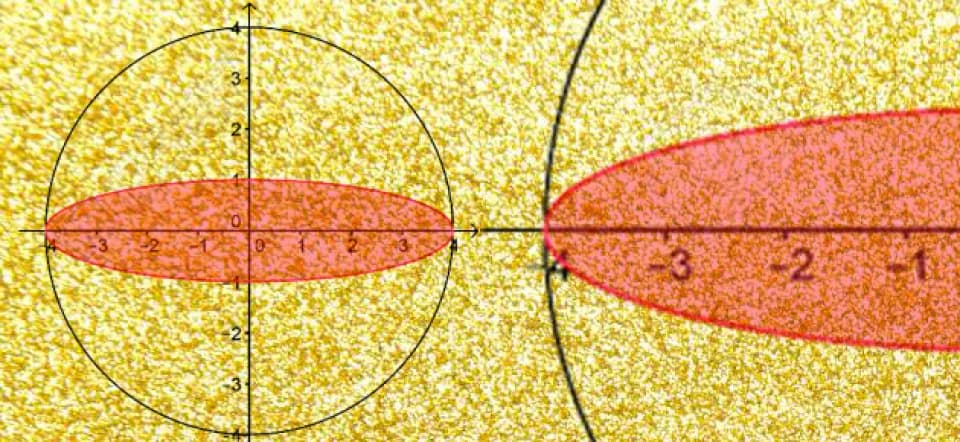
From an early age, we learn the formulas for the area and perimeter of familiar shapes such as squares, rectangles, triangles and disks. But what about the ellipse? To be precise, let us consider the ellipse with equation , where a is the semi-major axis and b the semi-minor axis. Since a circle is a special ellipse whose two semi-axes a and b are both equal to its radius R, replacing a and b by R in the formulas for an ellipse's circumference and area should recover the two familiar formulas: 2πR for the perimeter and πR2 for the area.
The limits of affine transformations of circles
-----------------------------------
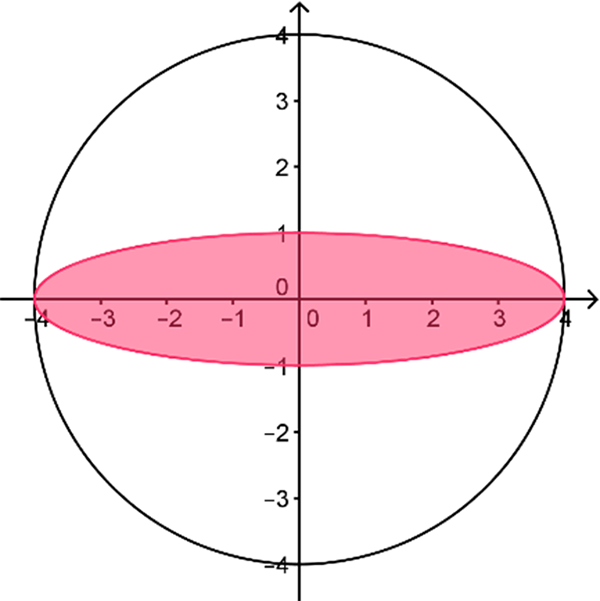
Let's begin by calculating the area. An ellipse can be viewed as a slightly flattened circle, so its area can be deduced from that of a disk of radius a. The ellipse is the image of the circle of radius a under the map that sends the point with coordinates (x, y) to the point with coordinates (x, (b/a)y). Since the disk's area is π*a 2, the ellipse's area is (b/a)× π*a 2, or simply πab. This formula can also be obtained using integration and, fortunately, gives the same result (see box).