-
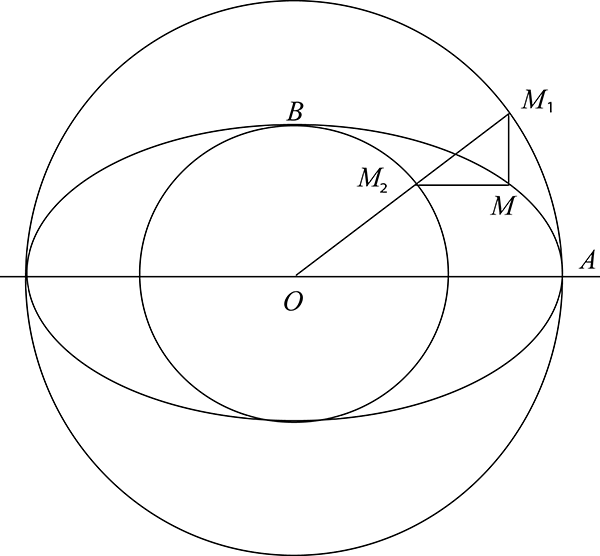
Draw a circle and one of its diameters, then draw several line segments perpendicular to the diameter, from the diameter to the circle, and mark their midpoints. By definition, these points form an ellipse whose semi-major axis is twice its semi-minor axis. More generally, project a point M1 on a circle of radius a = OA onto a point H on one of its diameters. Then all points M for which equals a constant k < 1 form an ellipse with semi-major axis a and semi-minor axis OB =b = ka.
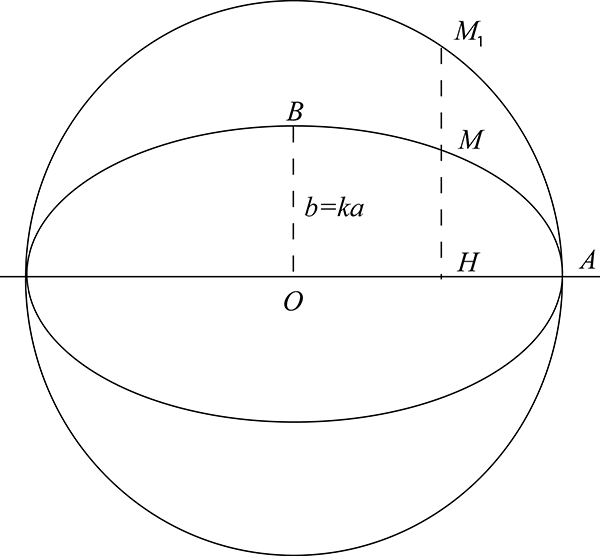
We have thus applied an affinity of ratio k. Remarkably, applying an affinity of ratio 1/k to a circle of radius b—stretching it horizontally instead of compressing the larger circle vertically—produces the same ellipse.
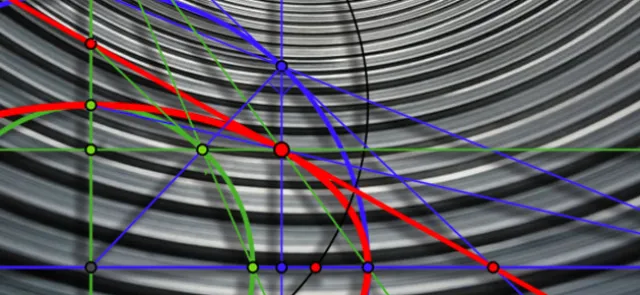
One notable consequence is that, by drawing two concentric circles of radii a and b, we can use this observation to construct the ellipse point by point with a straightedge alone, as illustrated below.