



At the heart of the ellipse
With the parabola and the hyperbola, the ellipse is one of the three conic sections. First examined in the context of solving problems requiring tools beyond the straightedge and compass, such as the duplication of the cube, they were later unified by their geometric definition as the intersection of a plane and a cone. The ellipse, which may seem to be merely a flattened circle, exhibits surprising properties, whether concerning the calculation of its perimeter, various construction methods one might devise, or the practical properties allowed by its focal definition, one of which is the proof of heliocentrism.
All articles in this folder
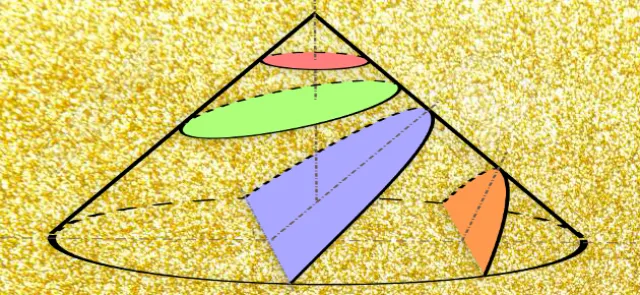
A little something missing
The term "ellipse" differs from the names of the other two conics, the parabola and the hyperbola. In fact, it means "something missing". Behind this surprising etymology lies a mathematical revolution: Apollonius of Perga's theory of conics.
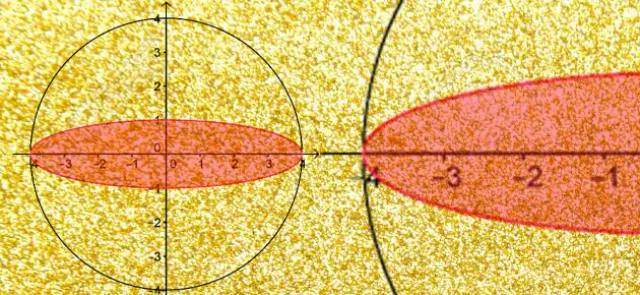
A question of circumference
You might expect calculating the perimeter of an ellipse—a fairly ordinary shape—to be straightforward. Yet it is a problem on which mathematicians have displayed extraordinary ingenuity. And in the formula contest, Ramanujan wins!

Ellipse snippets
There are several ways to construct an ellipse. Here are a few.
Kepler, or the defeat of the circle
Kepler's first law states that planets follow elliptical orbits around the Sun. How can this be proved with the bare minimum of theory? To answer this question, physicist Richard Feynman produced a little gem of classical geometry applied to celestial mechanics.