



BENOIT RITTAUD
40 articles published in Tangente
 History and CultureN°98Jun 08, 2026
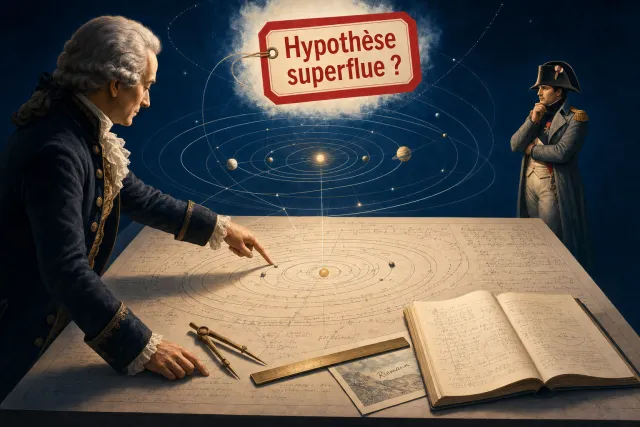
Defiant minds: when mathematicians challenged God
Laplace, Erdős and Hardy: three anecdotes about mathematicians who used logic and mathematics to question the existence of God.
Read → Maths and philosophyN°98Jun 08, 2026
Pascal's Wager: when probability meets faith
An explanation of Blaise Pascal's famous argument about the wager of faith, applying probability theory to the question of God's existence.
Read →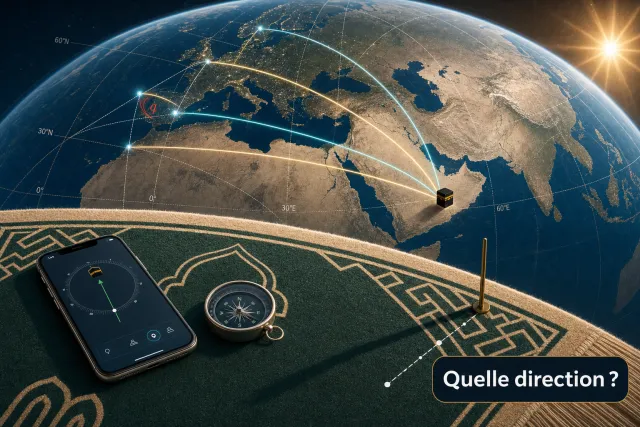 Applied MathN°98Jun 08, 2026
How to determine the qibla: a problem in spherical trigonometry
Discover how Muslim tradition inspired elegant mathematical solutions for finding the direction of Mecca, combining spherical geometry and astronomy.
Read →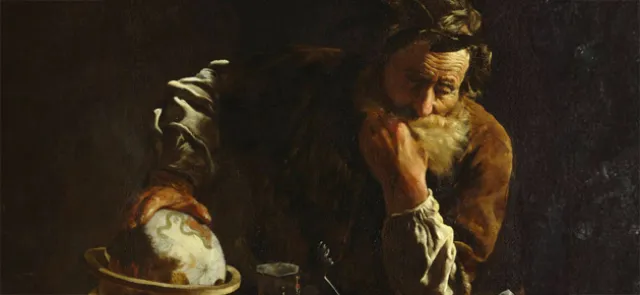 History and CultureN°229Apr 22, 2026
Turning the world into an arena
If the universe is finite, then it can be filled with grains of sand. Yes, it would take a great many, but the quantity required would still be a finite number—one that can be expressed. Drawing on the most advanced astronomical knowledge of his time, Archimedes set out to do just that.
Read → Math for everyoneN°226Oct 10, 2025
Celestial parabolas
Imagine the Solar System as a collection of different bodies—planets, comets…—subject only to the Sun’s gravitational pull. Classical mechanics then tells us that their orbits can trace only three types of curve: ellipses, hyperbolas and parabolas.
Read → Math for everyoneN°226Oct 09, 2025
Straightening the curve
The quadrature of the parabola was one of the first triumphs of ancient geometry in the study of areas bounded by curved lines — a success wrested through fierce struggle by Archimedes, before more modern methods simplified and generalized the result.
Read →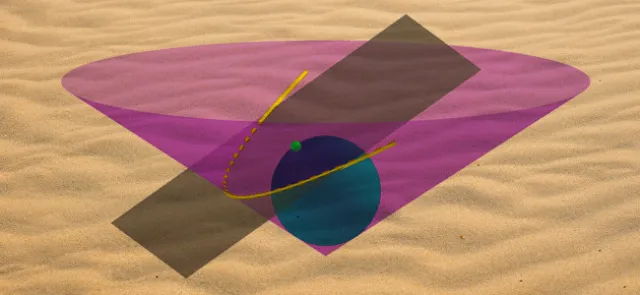 Math for everyoneN°226Oct 09, 2025
A line, a point, that's all
The parabola is one of the simplest curves to define, yet also one of the richest, with properties that make it a flagship object in classical geometry as much as in algebra and analysis. It thus offers an opportunity to bring together different mathematical perspectives.
Read →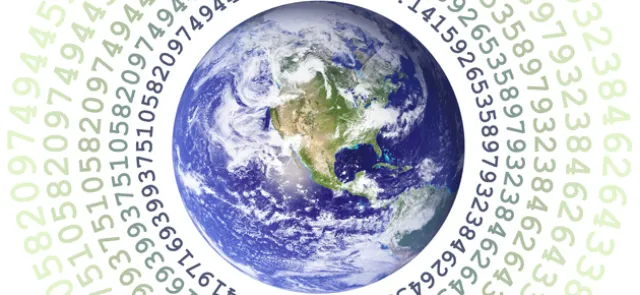 Math for everyoneN°95Aug 21, 2025
A mnemonic for the number π
Whether for doing mental arithmetic or impressing the crowd, certain numerical values need to be learned by heart. The digits of π are an important example, but a particularly tricky one to memorize, since they follow no simple pattern. To overcome the difficulty, nothing beats alexandrine verse.
Read →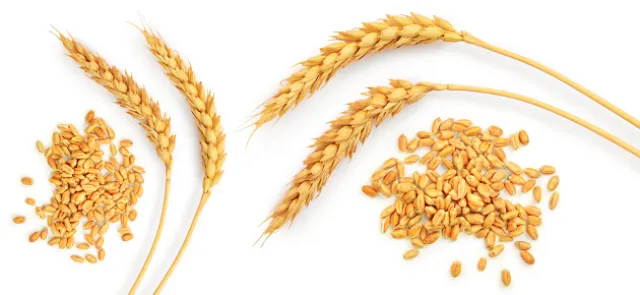 Math for everyoneN°95Aug 21, 2025
Grains on the chessboard and other high powers
Are billions, trillions, quadrillions and the like beyond our grasp? Not necessarily. With approximate calculations, many immense numbers become perfectly intelligible.
Read →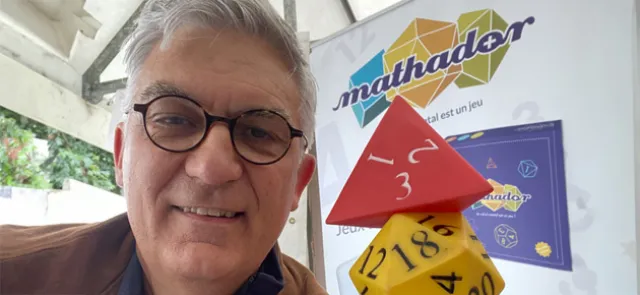 Math for everyoneN°95Aug 20, 2025
Éric Trouillot: "Mental arithmetic is a path to jubilation!"
The inventor of the calculation game Mathador, Éric Trouillot is one of those working to bring mental arithmetic back into teaching practice. In his view, far from being tricks performed by trained monkeys, techniques for calculating in one's head are an excellent gateway into the world of numbers, as well as an irreplaceable way to put mathematical properties — such as the distributivity of multiplication — into concrete practice.
Read → Math for everyoneN°95Aug 20, 2025
Getting started: a few tricks
A few tricks can make mental arithmetic more efficient
Read → History and CultureN°221Dec 17, 2024
Kepler, or the defeat of the circle
Kepler's first law states that planets follow elliptical orbits around the Sun. How can this be proved with the bare minimum of theory? To answer this question, physicist Richard Feynman produced a little gem of classical geometry applied to celestial mechanics.
Read →