The observations available to Newton were essentially Kepler's three laws, formulated empirically in the early 17th century and thoroughly tested against planetary motions. The first law states that each planet follows an elliptical orbit, with the Sun at one focus. The second states that the area of the parallelogram spanned by the position and velocity vectors—to use modern terminology—is constant. Finally, the third law states that the square of the period is proportional to the cube of the ellipse's major axis.
In an attempt to account for these findings, Isaac Newton (1642–1727) proposed two interlocking axioms that laid the foundations of a mathematical method for solving problems in physics:
1) An isolated body moves uniformly in a straight line: its velocity does not vary over time, and so, apart from this constant velocity, its motion "is as nothing". This observation was made by Galileo, a contemporary of Kepler…
2) Conversely, if a body's velocity changes over time, it is under the influence of a force—an action defined by precisely this effect. This amounts to a definition of force, and in "simple" cases Newton's famous equation of motion relates the sum of the forces acting on a body of mass m to the rate of change of its velocity . We write:
Experiments showed that this mass m had to be introduced. It allows the same force to have different effects on velocity—think of that force acting on a mosquito and on a commuter train…
-
Ancient geometry
------------------------
As well as giving physics a tool for investigation, Newton's definition lets us ask questions about nature—and sometimes answer them. Newton postulated gravitation by observing, or simply considering, the fall of various bodies. The reasoning is simple. An apple on its tree is still. Suddenly, it falls. Before it came loose from the tree, its velocity was zero. We then see it accelerate until it stops abruptly on hitting the ground. Its velocity has changed, so it must be subject to a force. At the Earth's surface, that force makes an apple fall five metres in one second—try it for yourself!
It is much the same for the Moon. Imagine that the Moon's velocity did not change, at least not in direction: how could it remain in orbit around the Earth?
If the Moon travelled in a straight line without being subject to any force, after one second it would be at point P in the diagram, which is obviously not to scale. In reality, because of the force exerted on it by the Earth, it is at point Q. The distance fallen is therefore PQ. Since antiquity, the Moon's orbit has been known to be "almost circular" and its motion uniform. The Moon's velocity at M is therefore tangent to the orbital circle and hence perpendicular to the line segment OM. The vector lying along the line determined by this velocity is therefore perpendicular to the vector . Thus, triangle OMP is right-angled at M.
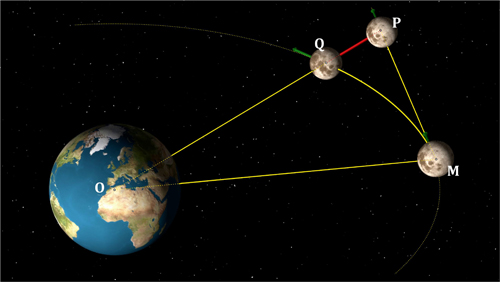
Furthermore, the Moon returns to roughly the same place in the sky every twenty-eight days, and since antiquity—with Aristarchus of Samos—parallax measurements had shown that the Moon was sixty Earth radii from the Earth. The Earth's radius had also been determined by the Greeks—with Eratosthenes of Cyrene—and is R E = 6,400 km. We can therefore calculate the magnitude of the Moon's velocity: our satellite travels around a circle whose circumference can be determined in twenty-eight days. This gives:
v = 2π × 60 × 6,400 / (28 × 24 × 3,600) = 1 km / s,
one kilometre per second. This remarkable result gives the magnitude of the vector , which is therefore 1 km.
Thus, in the right triangle OMP, we know the lengths MP and OM. The Pythagorean theorem then gives (OQ + QP)2 = OM2 + MP2. Since OQ = OM on the circular orbit, we can solve a quadratic equation to obtain QP = 1.3 mm. Every second, the Moon falls a little over a millimetre, thereby remaining in circular orbit around the Earth…
-
Towards a universal law
-------------------------
The matter took on a whole new dimension when Newton proposed that the force making the apple fall was the same force that made the Moon fall, and that it depended only on the distance from the Earth's centre: apples in Lincolnshire and Australia alike, as well as the Moon, move towards the Earth's centre… This force would therefore be universal—but how did it depend on distance from the Earth's centre? To find out, compare its effects. An apple one Earth radius from the Earth's centre falls five metres in one second. The Moon, sixty times farther away, falls only 1.3 mm, or 5 / 60 2.
That was enough for Newton to propose that this universal gravitational force varied inversely with the square of the distance. The rest was a matter of units: the expression for this force had to depend on both masses, and the force had to be zero if either mass was zero. In Newton's theory, no mass means no gravitation… Intuitively, the simplest approach was to place the product of the two masses in the numerator of the expression for the force's magnitude.
The magnitude then had to be adjusted to match the observed effects, while ensuring that the resulting formula had the units of force—that is, the units of mass multiplied by acceleration. Newton was therefore led to introduce what physicists call a fundamental constant, which resolves this kind of problem.
He set G = 6.67 × 10 –11 m3 kg–1 s2.
He thus obtained
or equivalently
This formula gives the gravitational force exerted by a body of mass M on a body of mass m, assuming that both are point masses separated by a distance r.
The vector has magnitude 1 and points from M towards m (which explains the sign, since attracts m towards M): it specifies the direction of the force. The gravitational constant G supplies the necessary scale factor.
Purists will have noticed that, following Newton, we assumed that the two masses were point masses and that the force exerted by m on M did not alter M's velocity. In other words, M is "much more massive" than m, as is indeed the case for the Sun relative to the planets…
-
Introducing fluxions
---------------------------
The fact that is always directed along also shows that the vector perpendicular to both and , whose magnitude equals the area of the parallelogram spanned by these two vectors, is constant. This vector does not change over time, although and do. This is Kepler's second law.
Part of the difficulty of Newton's problem lies in the fact that the unit vector defining the direction of the line through M and m varies over time. Although M may be assumed fixed, the same is not true of m, which is subject to the gravitational influence of the massive body: the distance r is a function of time. The vector does not change in magnitude, since it remains a unit vector, but its direction changes as it follows the mass m through its motion.
To tackle the problem of the Earth's motion around the Sun, Newton began with a little differential calculus, or the theory of fluxions, as he called it. Choose a fixed coordinate system in which we can resolve the unit vector . Mathematicians call it a Cartesian coordinate system; physicists call it a Galilean frame. Take it to be orthonormal. Draw a diagram in the plane of the motion.
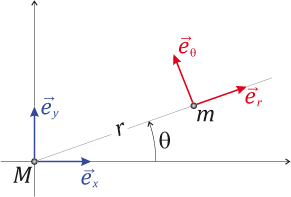
We have The time dependence of is thus transferred to θ = θ (t), while the unit vectors and are now fixed.
Differentiate with respect to time:
The vector is therefore also a unit vector; it is obtained by "rotating" through π/2 radians:
The frame is therefore orthonormal; it is called a local polar frame (it is "local" because it must be reconstructed at every instant). Differentiating with respect to time gives:
, or equivalently .
Substituting into Newton's second law gives:
Expressing and in this local polar basis, a straightforward calculation shows that the area Λ of the parallelogram they span at each instant is Λ = r 2 dθ / dt. Thus, the vector has constant magnitude.
Ultimately, thanks to all these miracles, Newton's second law reduces in this problem to
, or equivalently
The Hamilton vector is therefore constant! And it lies in the plane of the motion.
-
Characterizing the orbit
---------------------------
To characterize the orbit of m around M, Newton relied on diagrams alone. Follow his reasoning, using a more modern tool: the dot product (see Vecteurs et Espaces vectoriels, Bibliothèque Tangente 65, 2018).
The dot product of vectors and is defined by
Substituting the value of , we obtain
Now, vector is directed along
Thus,
$\begin{align} \widehat{(\overrightarrow{u},\overrightarrow{v})} &= \widehat{(\overrightarrow{e_\theta},\overrightarrow{v})}= \widehat{(\overrightarrow{e_\theta},\overrightarrow{r})} +\widehat{(\overrightarrow{r},\overrightarrow{v})} \cr &=-\frac{\pi}{2}+\widehat{(\overrightarrow{r},\overrightarrow{v})},\cr \end{align}$
hence
and finally
It follows that .
Using and choosing the origin of the angles so that , we obtain the fundamental relation: , where and .
There we have it at last! This relation between r and θ defines a conic with focal parameter p and eccentricity e (see l’Unification des coniques, Tangente 162, 2015, and Propos elliptiques, Tangente 163, 2015). Newton solved the problem without solving a single differential equation, using virtually nothing but geometry! Kepler’s ellipses follow from a logical deduction based on the definition of force as applied to gravitation.
-
With straightedge and compass…
------------------------
Geometry enthusiasts will want to construct the resulting trajectory point by point, with straightedge and compass, from the position and velocity at a given instant t. To do so, they must construct the locus of the velocities…
At each instant, the velocity vector can be written as . Writing ? *x and ? y for the Cartesian coordinates of the constant vector and using the expression obtained for at each instant t*, we obtain:
The locus H of the velocity vectors parametrized by time (the hodograph) therefore lies on a circle of radius u whose center has position vector . The hodograph H is the entire circle if θ(t) ranges over the whole interval [0, 2π], and only an arc of that circle otherwise. For the periodic orbits of the planets around the Sun, the hodograph is of course the entire circle…
We can even describe all this more precisely in terms of the eccentricity e of the resulting conic. We can also always choose physical units such that and hence .
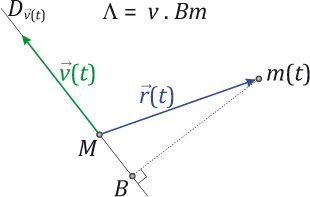
The hodograph can be constructed using only straightedge and compass. In the diagram opposite, the origin of velocity space is point M, the origin of the Cartesian coordinate system; represents the velocity of point m, assumed known, at time t.
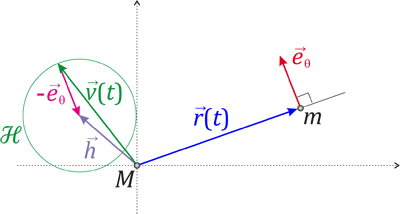
Let us begin by measuring Λ, the area of the parallelogram formed by the position and velocity at time t. We project the position vector orthogonally onto the line spanned by the velocity vector, obtaining B.
For each new point on the trajectory, at time t’, we proceed in three steps. Assume that the hodograph H is the entire circle (a periodic orbit). Choosing another point on H gives a new velocity vector . The constant Hamilton vector then allows us to construct . Rotating this vector through –π/2 gives the unit vector , which determines the direction of the line .
The mass m at time t’ lies on the line ; how can we determine its position? We need only use the fact that the area Λ of the parallelogram formed by the position and velocity has not changed! As we move m(t’) along the line , its orthogonal projection B onto also moves.
Finally, once , we have found the vector .
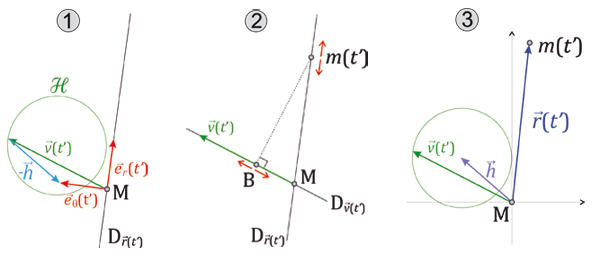
We repeat this geometric algorithm for each new velocity. Since all these constructions can be carried out with straightedge and compass, we can plot the orbit point by point!