



From observing nature to mathematical thinking
The study of the movement of celestial bodies illustrates the transformation in the physicists' relationship to mathematics. After Newton's synthetic method, Lagrange's analytical method, exploiting the power of integral calculus, gave rise to the theory of differential equations. A century later, under the inspiration of Henri Poincaré, the same problem will carry the beginnings of dynamical systems.
All articles in this folder
A science in motion | Tangente
Neither mathematics nor physics stands still! Until recently, the two disciplines went hand in hand, offering a natural philosophy. They sought to uncover, describe, and explain nature's hidden laws.
Newton's synthetic method
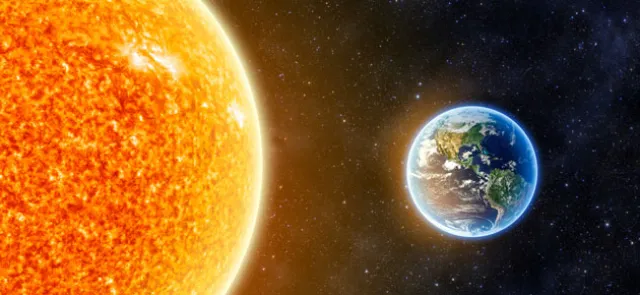
How does the Earth, of mass m, move around the Sun, of mass M, under gravity alone? To answer this question with something more than philosophical assertions, Newton proposed a synthetic method inspired by the description of motion.
Lagrange and the analytical method
At the time of his death, Isaac Newton was proud to have found a method for solving problems in natural philosophy, but he was aware of its limitations. The Moon's trajectory is described only very approximately by the two-body problem. It fell to Joseph-Louis Lagrange to make a spectacular breakthrough.
From the three-body problem to mathematical chaos
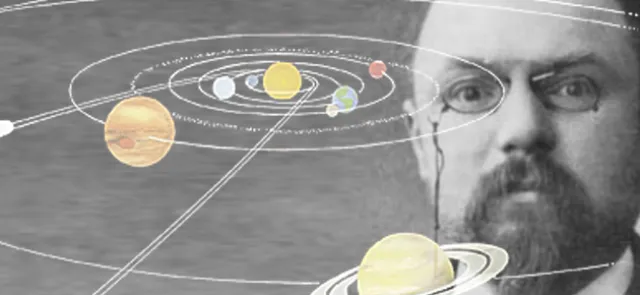
The elusive three-body problem saw spectacular progress thanks to Henri Poincaré. The French mathematician went further, devising new, more geometric methods for studying dynamical systems. His research has shaped our understanding of the stability of the solar system.