The importance of the problem of the quadrature of the hyperbola was championed by Marin Mersenne in the early 17th century. In modern terms, the problem is essentially to determine the area A(a) bounded by the curve H with equation y = 1/x, the x-axis (Ox), the vertical line with x-coordinate 1 and another vertical line with an arbitrary x-coordinate a.
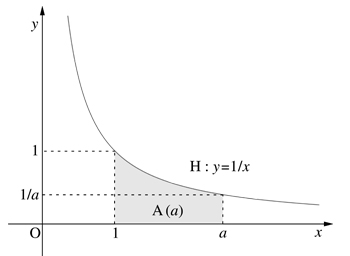
In the early 17th century, there were several good reasons to take an interest in this problem. First, the hyperbola is one of the three "conic sisters"—along with the ellipse and the parabola—curves that had been known and used since antiquity and whose scientific importance had suddenly extended far beyond geometry. A few years earlier, Galileo had discovered that, on Earth, the path of a projectile unaffected by drag is a parabola, while Johannes Kepler had proposed using ellipses to account for the motion of the planets.
Another, more mathematical reason for the interest in the hyperbola was that Pierre de Fermat had just found the quadrature of every curve of the form y = *xu. In modern terms, he had found an explicit expression for an antiderivative of the function f(x) = xu; this is the celebrated formula xu*+1/(u+1), valid for every value of u—with the sole exception of u = –1, the case of the hyperbola, for which the formula makes no sense.
Baffled by the hyperbola
-----------------------