The logarithmic derivative
------------------------
Differentiating the natural logarithm of a differentiable function f with strictly positive values can sometimes simplify certain computations. This new derivative has a name: it is the logarithmic derivative; it is formally defined by L( f ) = f‘ / f.
It satisfies remarkable properties: if g is another differentiable function with strictly positive values, then
•
•
• if α > 0 is a real exponent, L(f α) = (f α f ') / f α = α L(f), functional relations that are obviously reminiscent of the properties of the logarithm…
-
The logarithmic spiral
------------------------
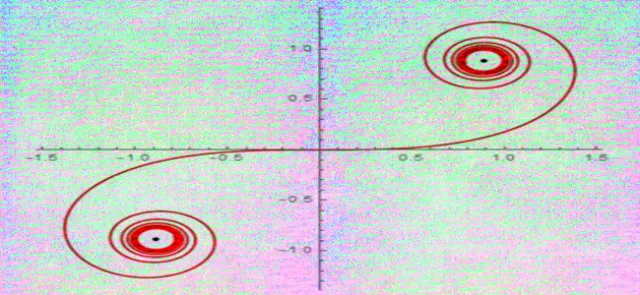
The logarithmic spiral, so often found in nature — on seashells, in the heart of sunflowers, or in the shape of galaxies — is a plane curve with polar equation r = aem θ, where a is a positive real number and m a nonzero real number. It is the path of a point M moving along a line through O with a speed proportional to OM, the line rotating about O at a constant speed. Studied by Descartes and Torricelli, it was even the subject of an entire treatise by Jacques Bernoulli in 1691, who named it the "spira mirabilis" and had one engraved on his tomb. In his view, this curve possessed so many invariance properties that it deserved the motto "Eadem mutata resurgo" ("I rise again unchanged").
*
*
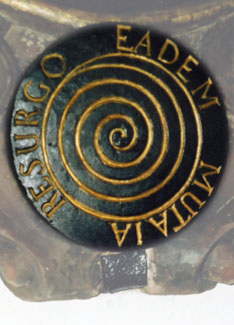
It is true that this curve, for example, cuts all its radius vectors at the same angle and that it is invariant under a similarity transformation of angle θ 0 and ratio e m θ0. It is a pity that the sculptor engraved an Archimedean spiral (with polar equation r = k θ) instead…
An "almost" logarithmic spiral on Jacques Bernoulli's tomb in Basel.
-
Logarithmic scales in science
--------------------------------------
To graduate a line D, you can use a linear scale which, once an origin O has been chosen, assigns to every point M of D the real number t, its x-coordinate, proportional to the distance OM. Here, two graduation marks whose differences are equal are a constant distance apart.
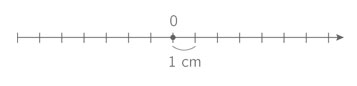
You can also, especially when the values span a wide range, define a logarithmic scale which, to every point M of D, assigns the real number t such that the logarithm of t (in any base, though base 10 — the decimal logarithm — is often chosen) is proportional to the distance OM. There, two graduation marks whose ratios are identical are a constant distance apart.
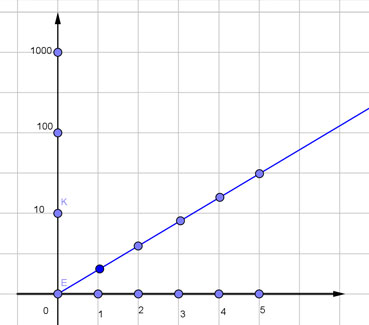
For a coordinate system in the plane, you can also graduate one axis on a linear scale and the other on a logarithmic scale: this gives a semi-logarithmic scale. In this way, identical growth rates are represented by line segments with the same inclination relative to the x-axis.
Logarithmic scales are ubiquitous in the sciences. In chemistry, pH is defined as –log C, where C represents the concentration of H3O+ ions in a solution. In acoustics, the sound level S, measured in decibels, equals 10 log(I/I0), where I is the sound intensity and I0 a reference intensity, namely the threshold of audibility of the human ear. The famous "Richter scale", introduced in 1935 in seismology to describe the magnitude M of an earthquake, is expressed in a similar way: M = log(I/I0), where I is the intensity of the earthquake being studied and I0 a reference intensity. The magnitude M of stars in astronomy, equal to log(E/E0), where E is the brightness of the star being studied and E0 a reference brightness, is likewise a common example of a logarithmic scale.