Logarithms turn multiplication into addition, a far easier operation to perform. Likewise, they turn division into subtraction and exponentiation into multiplication. An exponential function does the reverse. A simple way to define a logarithm, then, is to invert an exponential function. Let us see how this works in base 10. By definition, log x is the number y such that x = 10*y*.
Thus, log 1 = 0, log 10 = 1, log 100 = 2, etc. Here is a short excerpt from a table of base-10 logarithms:
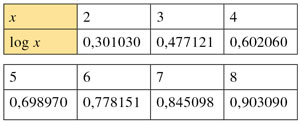
We can check from the table that log 4 = 2 log 2 and log 6 = log 2 + log 3. In general, to calculate the product of two numbers, say 12.132 and 5.456, we look up their logarithms in the table. Here this gives log(12.132) = 1.083932402 and log(5.456) = 0.7368743616. We then add these two numbers to obtain the logarithm of the product P: log P = 1.820806764. Reading the table in reverse, we obtain P by raising 10 to that number, hence P = 66.19219211, which gives the exact result of the required calculation after truncating the last two decimal places.
Using logarithm tables therefore called for dexterity and great care when adding. The accuracy of these tables determined the accuracy of every calculation, particularly those once performed by sailors to calculate the course they needed to follow. An error could cause a shipwreck—and indeed did so several times. Since they were compiled by hand, logarithm tables contained a great many errors. This was why Charles Babbage (1791–1871) set out to build a machine that could produce them. Indeed, the first computers were used for precisely this purpose…
The natural logarithm
---------------------